
10 Indian baby names aligned with numerology number ‘4’

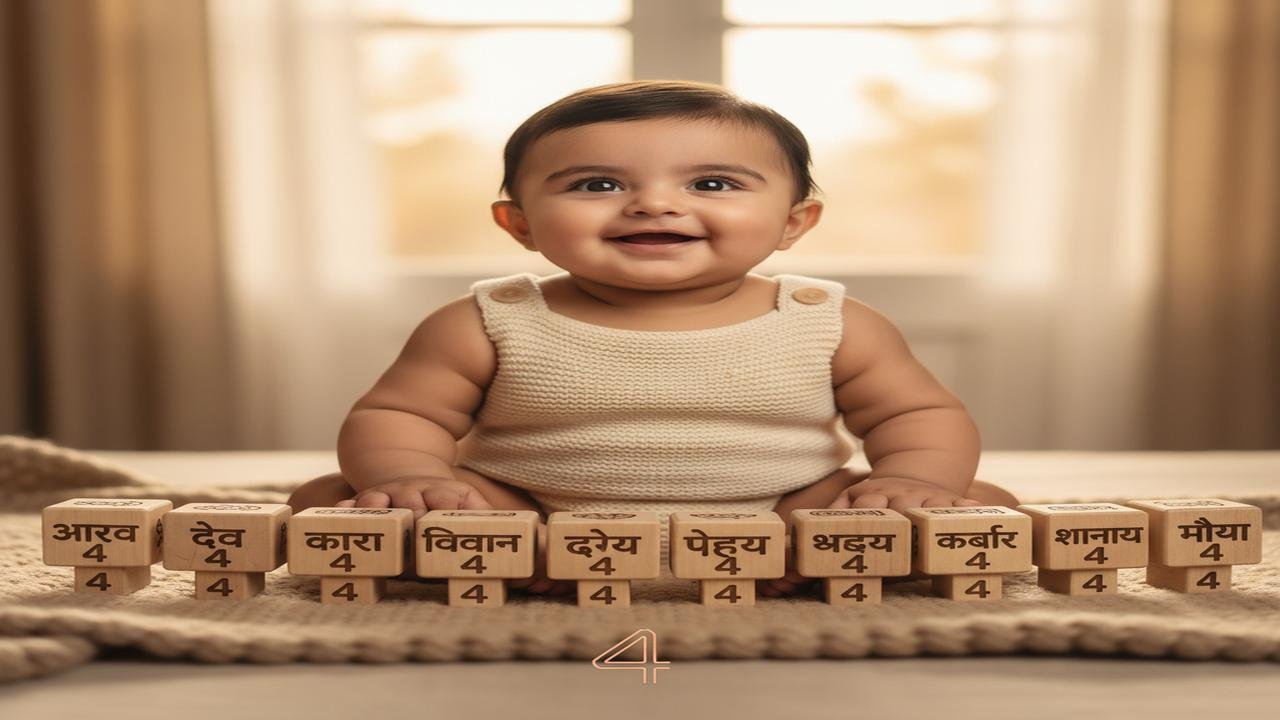
Names, numerology and tradition: a brief note
In many Indian families the choice of a baby’s name — nāma — and the rite of naming (nāmakaraṇa) are shaped by language, family lineage, astrological charts and, for some, numerology. Numerology is a system of symbolic interpretation rather than a single scriptural prescription; different schools (Pythagorean, Chaldean, even alphabet-to-akshara mappings in Devanagari) give different numeric assignments. What follows uses one common, simple letter-to-number method and shows how to arrive at names whose numeric root reduces to 4. Numerology attributes (like discipline, steadiness or practical intelligence often linked to 4) are interpretive and vary between practitioners; these notes are descriptive, not prescriptive.
Method used here (one common mapping)
For clarity I used the Pythagorean letter mapping where letters map to 1–9. To calculate a name’s number: add the numbers for each letter and reduce the total to a single digit (for example, 13 → 1 + 3 = 4). Here are the letter groups:
- 1: A J S
- 2: B K T
- 3: C L U
- 4: D M V
- 5: E N W
- 6: F O X
- 7: G P Y
- 8: H Q Z
- 9: I R
Note: other systems (Chaldean, or mappings based on Sanskrit aksharas) may give different totals. If your naming practice follows a particular religious or regional custom, consult a family priest or teacher for alignment with that tradition.
Ten Indian baby names whose numerology reduces to 4
Below are ten names from different linguistic and devotional backgrounds. Each entry shows the meaning, a brief cultural note, and the calculation that yields the final number 4.
Dev (देव) — male/common
- Meaning: “god, divine” (from Sanskrit deva).
- Cultural note: widely used across Śaiva, Vaiṣṇava and Smārta families as an element in longer names (e.g., Devendra).
- Calculation: D(4) + E(5) + V(4) = 13 → 1 + 3 = 4.
Sita (सीता) — female
- Meaning: “furrow”; the name of the principal heroine of the Rāmāyaṇa.
- Cultural note: strongly associated with Vaishnava devotion to Rāma; also revered across traditions for steadfastness and dharma (ethical duty).
- Calculation: S(1) + I(9) + T(2) + A(1) = 13 → 1 + 3 = 4.
Shreya (श्रेय) — female
- Meaning: “auspicious, excellent, fortunate.”
- Cultural note: the term shreya appears in classic Sanskrit literature to denote higher good; used as a devotional and aesthetic name.
- Calculation: S(1) + H(8) + R(9) + E(5) + Y(7) + A(1) = 31 → 3 + 1 = 4.
Kriti (कृति) — female
- Meaning: “creation, work” (often used for a literary or artistic composition).
- Cultural note: popular in modern use; evokes creativity and contribution.
- Calculation: K(2) + R(9) + I(9) + T(2) + I(9) = 31 → 3 + 1 = 4.
Maya (माया) — female
- Meaning: “illusion, creative power” (in some contexts an epithet of Goddess Mahāmāyā).
- Cultural note: the word has philosophical weight in Vedāntic discourse as well as devotional associations with the Goddess.
- Calculation: M(4) + A(1) + Y(7) + A(1) = 13 → 1 + 3 = 4.
Tara (तारा) — female
- Meaning: “star”; also a goddess name in Śākta and Buddhist traditions.
- Cultural note: revered in Tantric Śākta contexts and as a compassionate deity in Buddhist practice; widely used across India.
- Calculation: T(2) + A(1) + R(9) + A(1) = 13 → 1 + 3 = 4.
Chandra (चन्द्र) — male/family name element
- Meaning: “moon.”
- Cultural note: the moon-god Chandra features in Vedic hymns and later Puranic lore; used as a personal name or as part of compound names.
- Calculation: C(3) + H(8) + A(1) + N(5) + D(4) + R(9) + A(1) = 31 → 3 + 1 = 4.
Param (परम) — male
- Meaning: “supreme, highest.”
- Cultural note: appears as a prefix in many devotional names (e.g., Parameshvara); can be used independently.
- Calculation: P(7) + A(1) + R(9) + A(1) + M(4) = 22 → 2 + 2 = 4.
Shyama (श्यामा) — female
- Meaning: “dark, blue-black”; an epithet of both Goddess Kālī and Lord Krishna in different contexts.
- Cultural note: used in devotional poetry and song; crosses Śākta and Vaiṣṇava imaginations.
- Calculation: S(1) + H(8) + Y(7) + A(1) + M(4) + A(1) = 22 → 2 + 2 = 4.
Jagdish (जगदीश) — male
- Meaning: “lord of the world” (a name of Viṣṇu/Kṛṣṇa).
- Cultural note: traditional Vaishnava theophoric name, commonly used in many regions.
- Calculation: J(1) + A(1) + G(7) + D(4) + I(9) + S(1) + H(8) = 31 → 3 + 1 = 4.
Final notes and practical guidance
These names illustrate how a common mapping yields a numerological root of 4 while drawing from different strands of Sanskrit vocabulary, scripture and living tradition. If you follow a specific astrological or regional system (for instance, a Devanagari akshara-based mapping, or a Chaldean system), totals can differ; families often prefer to coordinate the choice with the child’s horoscope, guru or elder. Numerology complements, but does not replace, linguistic meaning, family practice, or devotional preference.
Practical caution: if naming ceremonies involve fasting, breathwork or other practices that could affect health, please take appropriate medical or elder guidance.
Respecting lineage, local custom and the name’s meaning will help ensure a choice that is both numerically considered and culturally rooted.
