
10 Indian baby names aligned with numerology number ‘7’

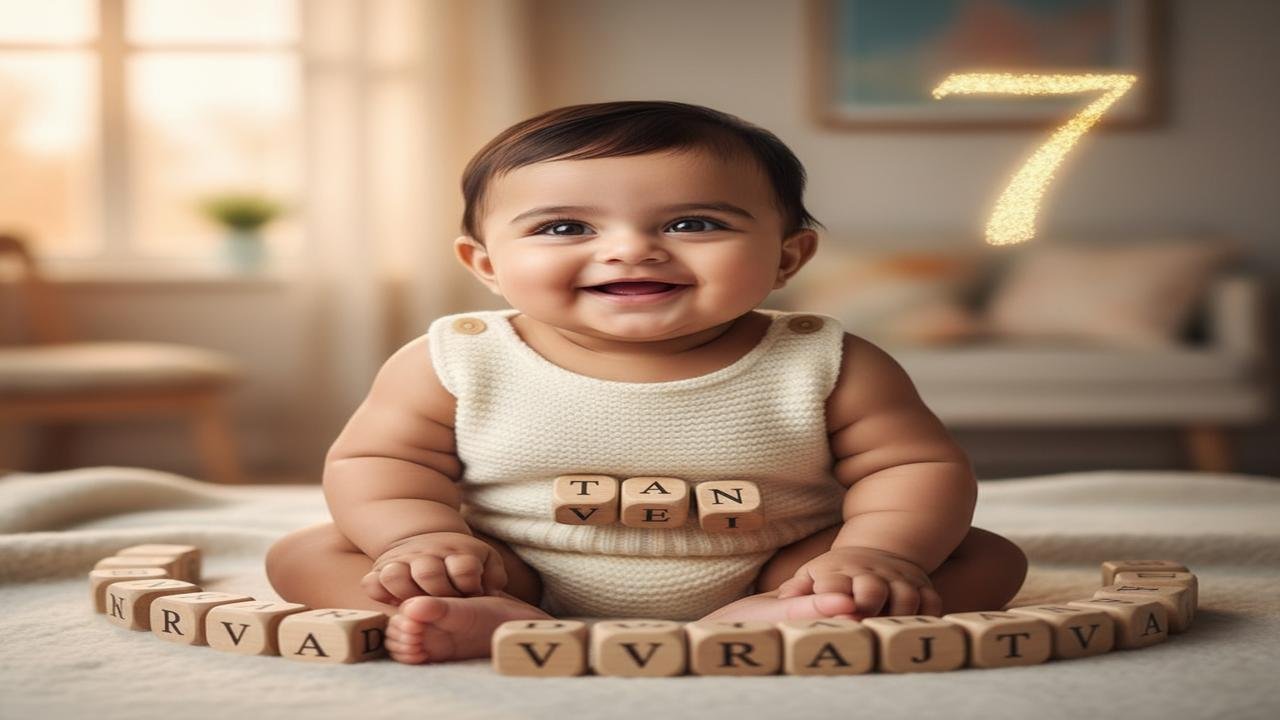
Why number 7 matters (and how I’m using it)
In many Indian spiritual and popular traditions the number 7 is associated with inquiry, inner knowledge and solitude — think of the seven chakras, the seven sages (saptarṣi) and the seven steps (saptapadi) in marriage rites. Numerology itself is interpretive: different systems (Pythagorean, Chaldean, Indian/Brahminic variants) map letters to numbers differently, and astrologers or family elders may prefer one method over another. Below I use the common Pythagorean letter-to-number mapping for English transliteration; this is a practical tool for families choosing a modern spelling that reduces to the single digit 7. Be aware that alternate spellings or a switch to a Chaldean table will change the result.
Letter-to-number mapping (Pythagorean)
- A=1, B=2, C=3, D=4, E=5, F=6, G=7, H=8, I=9
- J=1, K=2, L=3, M=4, N=5, O=6, P=7, Q=8, R=9
- S=1, T=2, U=3, V=4, W=5, X=6, Y=7, Z=8
How to calculate
Write the name in the chosen Roman spelling, add the numbers for each letter, then reduce the total by adding the digits together until a single digit remains (digital root). If that single digit is 7, the name aligns with numerology number 7 under this system.
Example (brief)
Rohit: R(9)+O(6)+H(8)+I(9)+T(2) = 34 → 3+4 = 7
Ten Indian baby names that reduce to 7 (with meanings and calculation)
- Rohit (m) — “red, first rays of the sun; a common classical name.” Calculation: R9 + O6 + H8 + I9 + T2 = 34 → 3+4 = 7. Association: used in many devotional and secular contexts; neutral across sects.
- Mohana (f) — “enchanting, attractive; one who captivates.” Calculation: M4 + O6 + H8 + A1 + N5 + A1 = 25 → 2+5 = 7. Note: Mohana is also an epithet sometimes applied to Krishna in poetic literature.
- Ishaan (m, unisex) — “lord, ruler; often linked to Ishana, a form of Shiva and also a directional name (northeast).” Calculation: I9 + S1 + H8 + A1 + A1 + N5 = 25 → 7. In Śaiva texts Ishana is one of the names of Śiva; in other contexts Ishaan is used as a secular name.
- Devika (f) — “little goddess; a name with roots in classical Sanskrit.” Calculation: D4 + E5 + V4 + I9 + K2 + A1 = 25 → 7. Devika appears across devotional and literary traditions.
- Lokesh (m) — “lord of the world (loka + īśa).” Calculation: L3 + O6 + K2 + E5 + S1 + H8 = 25 → 7. The component īśa is used in many theonyms; the name is culturally neutral.
- Vidya (f) — “knowledge, learning.” Calculation: V4 + I9 + D4 + Y7 + A1 = 25 → 7. Vidya is a classical Sanskrit term for knowledge; commentators across schools discuss different connotations of knowledge (jñāna, vidyā).
- Aarav (m) — “peaceful, calm; modern popular name often rendered with a double-ā.” Calculation (A A R A V): 1+1+9+1+4 = 16 → 1+6 = 7. Note: pronunciation and doubling of vowels affect transliteration and hence numerology.
- Gaurav (m) — “pride, honour.” Calculation: G7 + A1 + U3 + R9 + A1 + V4 = 25 → 7. The root gaura can also mean fair or golden in other contexts; the name is widespread.
- Yogesh (m) — “lord of yoga; one who is accomplished in spiritual practice.” Calculation: Y7 + O6 + G7 + E5 + S1 + H8 = 34 → 3+4 = 7. In Vaiṣṇava and Śaiva devotional settings Yogeshvara appears as an epithet for the divine, but Yogesh is also used broadly.
- Radhika (f) — “adored one; a name associated with Rādhā, beloved of Kṛṣṇa, and with devotion (bhakti).” Calculation: R9 + A1 + D4 + H8 + I9 + K2 + A1 = 34 → 7. The name has strong devotional resonances in Vaiṣṇava traditions but is commonly used by families of many backgrounds.
Practical notes and cautions
– Spelling matters: a different Romanisation (Rohit vs. Rohith) will change the calculation. If you are consulting a priest, astrologer or family tradition, agree on a standard transliteration first.
– System matters: this list uses the Pythagorean mapping. Chaldean numerology and other Indian letter-number schemes will produce different results; be clear which method your family prefers.
– Cultural sensitivity: some names have strong sectarian or devotional associations (e.g., Ishaan, Radhika). That does not make them exclusive, but families who want a neutral or a strongly devotional resonance should choose accordingly.
– Limits of numerology: numerology is a cultural practice, not a deterministic science. If you consult numerology as part of naming, consider combining it with linguistic meaning, family heritage, and, where appropriate, astrological naming customs (nāmakaraṇa). Keep expectations modest and practical; avoid claims of guaranteed life outcomes.
If you’d like, I can run the same ten names using the Chaldean table, suggest auspicious middle names to pair with any of these, or generate variations that preserve the number 7 while fitting a particular regional spelling or family tradition.
