
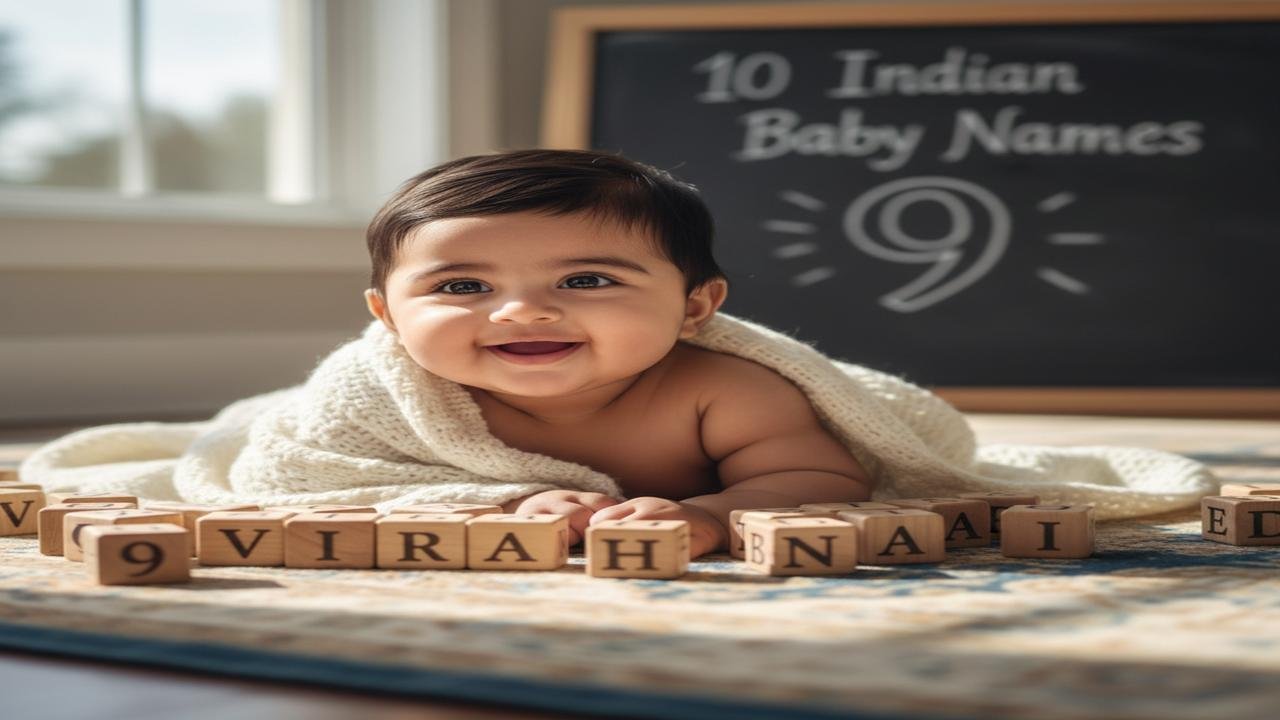
10 Indian baby names aligned with numerology number ‘9’

Introduction: what “9” means in popular Indian numerology
In many Indian numerology traditions the single digit 9 is associated with completion, compassion and public-mindedness; it is often described as the digit of the humanist, the artist or the leader who thinks in terms of the whole. Different schools use different letter-to-number mappings (Pythagorean, Chaldean and regional variants), so names that add to 9 in one system may not in another. Below I use the common Pythagorean mapping (A=1, B=2 … I=9, J=1 … R=9, S=1, etc.) and show compact calculations; if you prefer another system, spellings and transliteration will change the arithmetic.
How to check a name (Pythagorean quick method)
- Step: Convert each Roman-letter of the name to its Pythagorean number: A/J/S = 1, B/K/T = 2, C/L/U = 3, D/M/V = 4, E/N/W = 5, F/O/X = 6, G/P/Y = 7, H/Q/Z = 8, I/R = 9.
- Add the numeric values of all letters → get a total; then reduce by adding digits until you have a single digit. If that single digit is 9 (or the total is 9, 18, 27, 36 …) the name reduces to 9.
- Note: Spelling (Anita vs. Aneeta) or transliteration (Kumar vs. Qumar) will change the result. Numerology complements, not replaces, family traditions, astrological advice or legal considerations when choosing a name.
Ten Indian names that reduce to 9 (Pythagorean sums)
- Parth (male) — P(7)+A(1)+R(9)+T(2)+H(8) = 27 → 2+7 = 9. Sanskrit root: Partha, an epithet of Arjuna in the Mahābhārata; often evokes courage and dharma — ethical duty. Common in North India.
- Pranav (male) — P(7)+R(9)+A(1)+N(5)+A(1)+V(4) = 27 → 9. Pranava (प्रणव) is the sacred syllable Om; used across Vaiṣṇava and Smārta contexts. Connotes primordial sound, auspiciousness and spiritual opening.
- Anil (male) — A(1)+N(5)+I(9)+L(3) = 18 → 1+8 = 9. Sanskrit: Anila — “wind”; in some texts a name of Vāyu. Light, mobile, and often used in modern Indian contexts.
- Anita (female) — A(1)+N(5)+I(9)+T(2)+A(1) = 18 → 9. A name meaning “grace” or “favor” in popular usage; cross-cultural and widely familiar in Indian languages.
- Gayatri (female) — G(7)+A(1)+Y(7)+A(1)+T(2)+R(9)+I(9) = 36 → 3+6 = 9. Name of a Vedic meter and the famous Gayatri Mantra; carries strong liturgical and devotional resonance in many traditions.
- Mahesh (male) — M(4)+A(1)+H(8)+E(5)+S(1)+H(8) = 27 → 9. Sanskrit: Mahesha — “great lord,” a name often used for Śiva in Śaiva circles. Respectful devotion and classical grounding make it a longstanding choice.
- Ganesh (male) — G(7)+A(1)+N(5)+E(5)+S(1)+H(8) = 27 → 9. Lord Gaṇeśa (Ganesha) is widely invoked at beginnings; the name signals auspiciousness and remover-of-obstacles associations across sects.
- Mahima (female) — M(4)+A(1)+H(8)+I(9)+M(4)+A(1) = 27 → 9. From the Sanskrit mahima — “greatness,” “glory.” Used in devotional and literary registers; evokes dignity and expansiveness.
- Suresh (male) — S(1)+U(3)+R(9)+E(5)+S(1)+H(8) = 27 → 9. “Lord of the gods” in literal sense (su- + īśa); often associated with Viṣṇu or other high deities in popular use, and common as a pan-Indian personal name.
- Devesh (male) — D(4)+E(5)+V(4)+E(5)+S(1)+H(8) = 27 → 9. Devesh — “lord of the gods”/a divine ruler epithet; used with devotional overtones and in literary contexts.
Cultural and practical notes
- Meanings and associations: each name above carries linguistic roots and devotional/cultural associations (for example, Gayatri and Ganesha have strong ritual resonance). Families often weigh these associations alongside numerological alignment.
- Spelling matters: different Roman spellings (and local scripts) change the arithmetic. If you have a preferred orthography, re-run the calculation using the mapping you trust, or ask a numerologist who uses the Chaldean method if you prefer that tradition.
- Interpretive diversity: in Śaiva, Vaiṣṇava, Śākta and Smārta households the same name can have different devotional emphases; that pluralism is normal and can be a resource when choosing a name.
- Legal and social steps: many families consider astrology (janma nakshatra), family naming customs and caste/community naming practices alongside numerology. Changing a name later can involve administrative work and social adjustment.
- Non-medical caution: numerology is a cultural and symbolic practice; it is not a therapy or medical guidance. If naming discussions bring up emotional stress, consider talking with family elders or a counsellor.
Closing thought
Choosing a name is both a spiritual and social act: it links a child to language, to family memory and to community frames of meaning. Numerology can offer one set of criteria — a symbolic way to focus on qualities such as compassion and service often associated with the number 9. Combine that with meaning, sound, family tradition and the advice of trusted elders or ritual specialists, and you will have a name that roots the child in a living tradition while also reflecting contemporary sensibilities.
