
10 Indian baby names inspired by precious metals

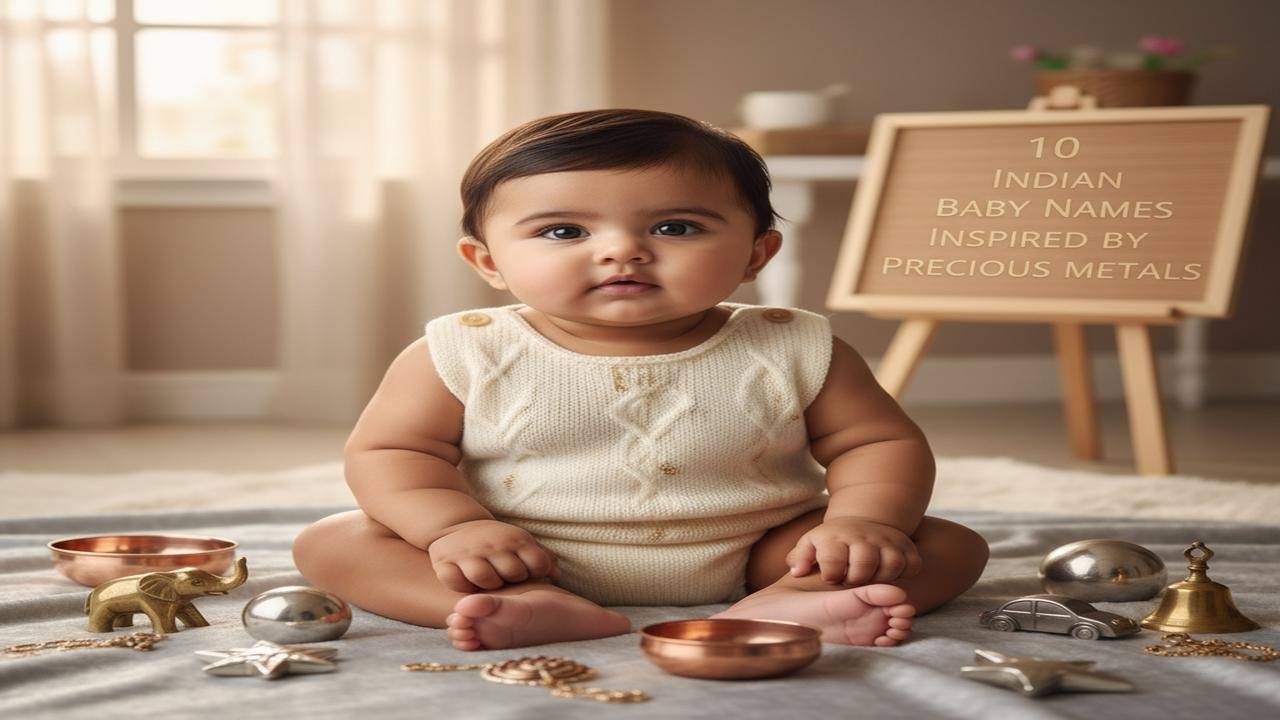
Why metals matter in Hindu naming
Metals like gold, silver, copper and iron carry long symbolic and practical weight in Hindu life. In Sanskrit texts and in temple practice they represent purity, wealth, durability and ritual function: *suvarṇa* — “gold” — appears as an epithet in Vedic and Puranic literature (for example, the cosmic term *Hiraṇyagarbha* or “golden womb”); *rajata* — “silver” — is associated with the moon and with liturgical vessels; *tamra* — “copper” — is the traditional metal of utilitarian temple and household vessels; *loha* — “iron” — is the common metal of tools and defensive implements. Different schools and regions read these symbols in varied ways, so the short notes below try to be descriptive rather than doctrinal.
Ten baby names inspired by precious metals
-
Swarna (Sanskrit: suvarṇa, pronunciation: soo-AR-na) — Meaning: “golden, made of gold.” Origin & usage: Classical Sanskrit; widely used across Indic languages as a feminine name. Cultural note: Gold is often linked with Lakshmi (wealth, prosperity) and with auspicious festive dressings of deities. Variants: Swarna, Suvarna, Swarupa.
-
Hiranya (hi-RUN-ya) — Meaning: “gold, treasure, golden.” Origin & usage: Vedic and Puranic; appears in compounds such as *Hiraṇyagarbha*. Gender: commonly unisex in classical usage. Scriptural note: *Hiraṇyagarbha* figures prominently in creation hymns of the Ṛgveda and later cosmologies; the word conveys a cosmic or sacred sense of “golden being” in many contexts.
-
Kanaka / Kanak (kuh-NAH-ka / KAH-nak) — Meaning: “gold.” Origin & usage: Sanskrit root *kanaka* — used across modern Indic languages. Gender: Kanaka often feminine; Kanak masculine variant is common in North India. Cultural note: Kanaka appears in temple and royal epithets and as a poetic synonym for splendor.
-
Kanchan / Kanchana (KAN-chan / kan-CHA-na) — Meaning: “golden, like gold.” Origin & usage: Sanskrit *kañcana*; very common as a feminine name in many Indian languages and as Kanchan for males in some regions. Ritual note: The adjective form stresses luminosity and beauty rather than raw bullion.
-
Hema (HAY-ma) — Meaning: “gold, golden.” Origin & usage: A short, classical Sanskrit name frequently used for girls. Literary note: Hema appears as an element in compound names (Hema-lata, Hema-vati) meaning “golden creeper” or “she who is golden.”
-
Hemant (HAY-munt) — Meaning & origin: layered. In classical Sanskrit it names one of the six seasons (early winter), but it derives from the same root *hema* (“gold”), carrying the sense of “golden/bright.” Usage & note: Common masculine name across languages; interpretive range includes seasonal and color associations as well as the gold-root.
-
Rajat (RAH-jut) — Meaning: “silver.” Origin & usage: Sanskrit *rājata*; used widely as a masculine name. Cultural note: Silver is traditionally associated with the moon (Chandra) and used for specific ritual vessels and ornaments. Variants: Rajath, Rajat.
-
Tamra / Tamraja / Tamraparni (TUM-ra / tum-RAH-ja / tum-ra-PAR-ni) — Meaning: “copper” (Tamra); Tamraparni is literally “copper-coloured leaf/stream” and used as a place and personal name. Origin & usage: Sanskrit *tamra*; Tamra(t) names occur in South and South-east Asian contexts. Practical note: Copper is valued for vessels and ritual paraphernalia in many regional temple traditions.
-
Lohit / Lohitha (LOH-hit / loh-EE-tha) — Meaning: derived from *loha* (“metal, iron”) or from the adjective “reddish.” Origin & usage: Sanskrit; Lohit is common for boys, Lohitha as a feminine form. Cultural note: *Loha* denotes metal broadly but later specialized to iron; the name often carries the sense of strength and colour rather than bullion value.
-
Kanaklata / Kanakavalli (kuh-NAK-lah-ta / kuh-NA-kah-VAH-lee) — Meaning: “golden creeper” / “golden vine.” Origin & usage: Compound names built from *kanaka* (gold) plus plant imagery; commonly feminine and found in Sanskrit and regional literature. Literary note: Such compounds are popular in devotional poetry where beauty and wealth are metaphorically linked.
Choosing a metal-inspired name — practical points
- Sound and regional fit: Many Sanskrit roots have local variants (e.g., Swarna / Suvarna / Swarn). Check how a name’s consonant clusters and vowels will sound in your mother tongue and with your family surname.
- Meaning nuance: Some names (Hemant, Lohit) carry seasonal or colour senses as well as a metal root; decide which nuance you prefer.
- Religious and literary resonance: Names like Hiranya carry Vedic and Puranic resonance (e.g., *Hiraṇyagarbha*); Swarna and Kanaka appear as epithets of Lakshmi and in classical poetry. If you wish a particular sectarian association, consult textual sources or a family elder; otherwise treat these as cultural layers rather than strict labels.
- Gender usage: Many metal-root names are flexible across genders in Sanskrit tradition; modern usage may be regionally gendered (for example, Rajat is mostly masculine, Swarna is mostly feminine).
Respect, hygiene and modest cautions
Metals are integral to temple practice — ornaments, plates, bells and kalash are often made of gold, silver, copper or bronze. If you plan metal-based rituals at home (e.g., using copper vessels), follow standard hygiene and priestly guidance; do not assume folk practices are medically neutral.
Closing note
Metal-inspired names carry rich layers: linguistic root, ritual usage, literary image and everyday object. The ten options above offer a cross-section — from the explicitly golden (Swarna, Kanaka, Kanchan) to the lunar and silvery (Rajat) and the earthy or strong (Tamra, Lohit). They work well alone or as part of compounds and, depending on family custom, can be adapted with affectionate short forms. If you want, I can suggest phonetic spellings for a particular region, check astrological compatibility (nakshatra-based preferences) or propose modern variants for each name.
