
108 Beads Why Your Mala Is a Map of the Cosmos

The Hidden Meaning Behind the 108 Beads of a Mala
When I first held my grandmother’s tulsi mala, she smiled and whispered, “One hundred and eight is a universe tucked into your palm.” As the smooth beads rolled between my fingers, the world felt quieter. It was not just a string. It was a path, bead by bead, guiding the mind back to the heart.
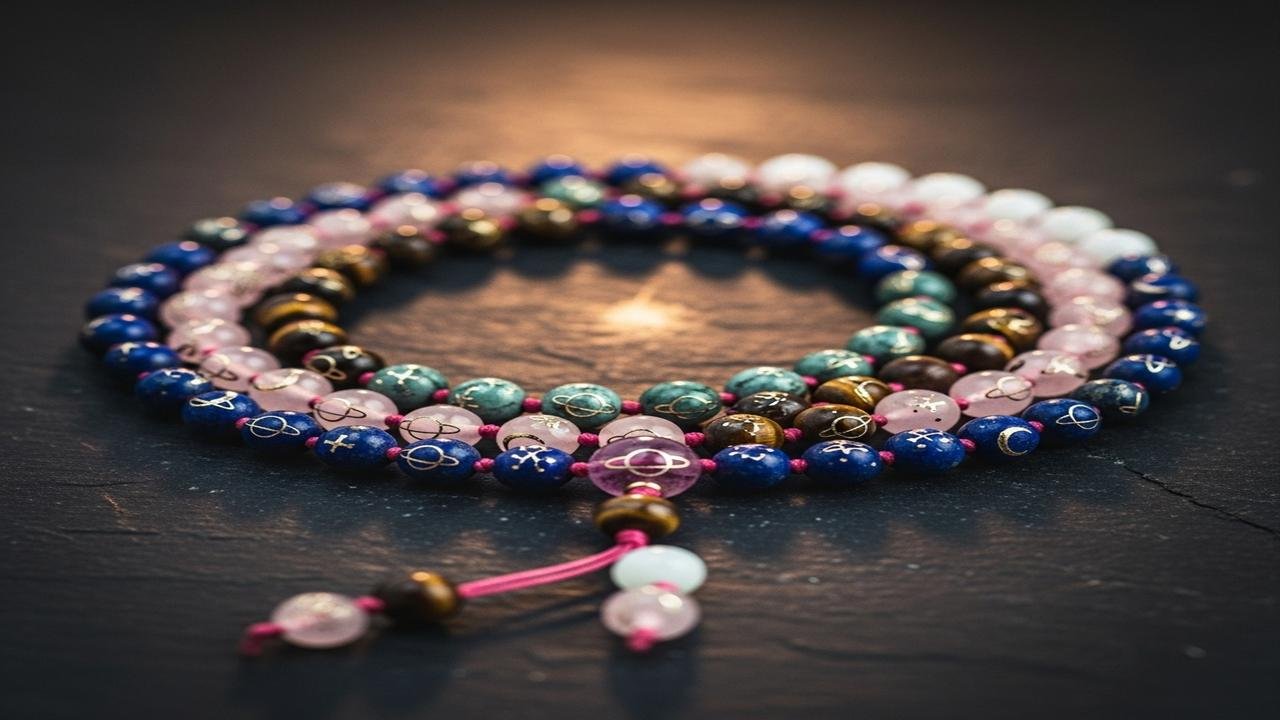
A mala, or japa mala, usually has 108 beads and one larger bead called the guru or meru bead. This special bead is not counted; it is a point of pause and gratitude. When a mantra is completed, the mala is turned around rather than crossing over the guru bead, as if bowing to the teacher within and without. In that simple act lives a deep spiritual etiquette—humility, reverence, and remembrance.
Why 108? Across India’s sacred traditions, this number shines like a hidden mantra. It appears in scriptures, in yoga, in dance, and even in the sky. Each meaning adds a petal to the flower of understanding:
- 1-0-8 as a symbol: 1 stands for the One, the Divine unity. 0 is the void, the stillness of pure potential. 8 mirrors infinity, the endless flow of life. Together, they say: from Oneness, through the Great Silence, into Infinite becoming.
- Cosmic counting: 12 zodiac signs multiplied by 9 planetary influences bring 108—hinting that every mantra round touches the full wheel of time and karma.
- Stellar rhythm: The sky is divided into 27 nakshatras, each with 4 padas—another 108. Your japa becomes a walk across the constellations.
- Sound and power: Tradition speaks of 54 basic Sanskrit sounds. When joined as Shiva (consciousness) and Shakti (energy), they become 108—sound turned into sacred presence.
- Scriptural fullness: Many hold 108 as the number of Upanishads—wisdom distilled into a count you can hold in your hand.
- Subtle body maps: Yogic lore describes 108 vital energy points and many nadis converging at the heart. Each bead is like a gentle knock on that inner door.
- Devotional tradition: We chant 108 names of deities or offer 108 flowers in puja, shaping devotion into a beautiful discipline.
When you sit with a mala, your practice turns these ideas into experience. Each bead is a breath. Each breath is a step. Over time, the mind learns to sit, the heart learns to listen. You may use the right hand, touching each bead with the thumb and middle finger while keeping the index finger—symbol of ego—away. You may set a sankalpa, a gentle intention, and let the mantra ride the rhythm of inhaling and exhaling. Softly, your inner world starts to clear, like a lake after the wind has passed.
In daily life, the mala becomes a quiet companion. Some keep it in a small cloth bag, close to the altar or tucked in a pocket during travel. A rudraksha or tulsi mala carries the fragrance of tradition; a sandalwood or gemstone mala holds a cooling, grounding touch. Yogis sometimes mark special days—equinox, solstice, or festival—by completing 108 rounds of a mantra or even 108 sun salutations. Students wear a mala to remember their teacher’s guidance. Busy professionals slip a bead between fingers during a commute, letting a single round of japa soften a long day.
What matters most is the attitude. Approach the mala with respect, like entering a sacred grove. Don’t rush. Let your mantra be your companion, not your task. Some days you finish all 108; some days you whisper only twelve. Grace works in both.
Slowly, the secret of 108 reveals itself—not as a number to analyze, but as a circle to complete. You begin at the guru bead with a prayer, journey through the 108 worlds of your mind, and return to the guru bead a little lighter, a little clearer, a little kinder.
Conclusion
The 108 beads of a mala are more than counting tools; they are a map of the cosmos, the body, and the heart. They echo astrology, Sanskrit, yoga, and devotion, guiding us gently from restlessness to remembrance. Hold your mala today, choose a simple mantra, and begin. Between the first bead and the last, you may discover that the Divine you seek has been moving with your breath all along.
