
Krishna As Father And Mother In Bhagavad Gita, Bhagavata

Context of the declaration
Across several Hindu texts and traditions, Krishna is presented not only as a personal deity but also as the source and sustainer of the cosmos. That language sometimes takes parental forms: Krishna as father, Krishna as mother. These images appear in canonical scripture, in Purāṇic narrative, and in centuries of bhakti (devotional) poetry. Different communities — Vaiṣṇava, Smārta, Śaiva, Śākta and others — read those images in distinct ways. The claim that “Krishna declares he is the father and mother of the universe” brings together scriptural assertions of divine origin and the devotional metaphors that describe the Lord’s intimate care.
Where the texts speak of origin and care
In the Bhagavad Gītā (often called the “Song of the Lord”) Krishna famously uses language of origin and pervasiveness. For example, in chapter 10 Krishna declares, “ahaṁ sarvasya prabhavo mattaḥ sarvam pravartate” — “I am the source of all; from Me everything proceeds.” That sort of statement is read by many commentators as asserting a parental-type relation: God as origin and sustainer.
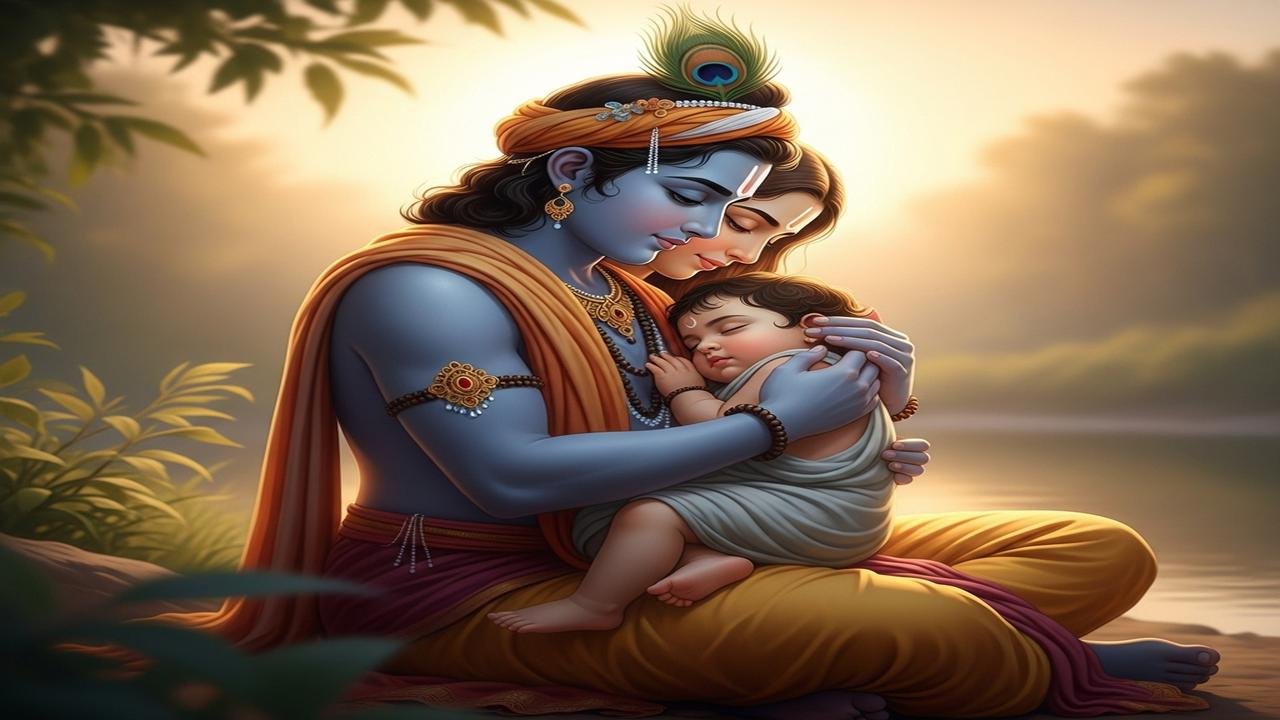
The Śrīmad Bhāgavata Purāṇa (Bhāgavata), the central Purāṇic text for many Vaiṣṇava traditions, cultivates close domestic images of Krishna — scenes of Yashodā (Krishna’s foster-mother) tending the child, and the gopīs (cowherd women) whose emotions range from maternal care to conjugal passion. Devotional literature then uses several relational “rasas” (aesthetic flavours): vatsalya (parental affection), śṛngāra (erotic love), sadhu-sakhya (friendship), etc. In the vatsalya rasa, Krishna is the child; the emotion is maternal or paternal care, and the divine is approached through parental love.
Paternal imagery: creator, protector, father
- Scriptural sense: Phrases that describe Krishna or Viṣṇu as the origin and regulator of dharma and the cosmos lend themselves to “father” metaphors. The father image highlights authority, guardianship, ordination of social and cosmic order.
- Ritual language: In many pūjā (worship) formulas and temple inscriptions, Viṣṇu/Krishna is invoked as pitā or nātha — language overlapping with paternal roles.
- Interpretation: Commentators who emphasise Krishna’s supremacy (akhanda-svarūpa) read these statements as metaphysical: the deity is the first cause. Others understand “father” as relational, not physical; it expresses provenance and care.
Maternal imagery: nurturer, intimate caregiver
- Vatsalya rasa: The maternal theme is strong in stories of Yashodā’s care and anxiety for the child Krishna. The Bhāgavata treats these scenes as theological as well as emotional — the supreme taking the posture of a beloved child to allow the devotee a maternal relation.
- Gopī devotion: In the rural Vraja setting, women’s songs and litanies celebrate Krishna as the centre of household and village life; maternal concern, protection from danger, and daily care become ways to know the divine.
- Theological angle: Some traditions highlight that the divine encompasses both masculine and feminine qualities. In that view, Krishna can be the compassionate mother as well as the protective father.
How different schools read these images
- Vaiṣṇava traditions: Tend to treat Krishna’s parental claims as expressions of his personal, supreme nature (saguna Brahman). The imagery supports intimate bhakti — devotees may approach Krishna as child, friend, lover or master.
- Advaita/Smārta readers: May read the statements as symbolic of Brahman (the impersonal absolute) manifesting as personhood; parental language can point to metaphysical dependence rather than literal parenthood.
- Śaiva and Śākta perspectives: Often accept devotional material about Krishna while interpreting his claims within broader theology that includes Śiva or Śakti as co-equal or primary, depending on the community.
- Regional and folk traditions: Local practices often integrate the maternal and paternal images in everyday ritual — they are lived metaphors more than doctrinal assertions.
Devotional practice and cultural expression
Practices reflect this dual imagery. Festivals like Janmashtami (Krishna’s birth) and Nandotsava emphasise familial roles: mothers enact care, men enact protective duties, and the community celebrates the Lord’s many moods. Bhajans, kīrtans and classical rāgas explore both tender maternal tones and authoritative royal ones. Temple iconography likewise ranges from the child Krishna (bālakrishna) to the majestic Rādhā-Krishna or Śrī-Viṣṇu forms.
Note: If devotional observances involve prolonged fasting, extreme sleep deprivation, or breath-control practices, those can affect health—seek medical advice before undertaking them.
Why both father and mother matter theologically
- Relational access: Using parental metaphors lets devotees relate to the divine in familiar, emotionally rich ways: dependence, tenderness, discipline and protection.
- Wholeness of the divine: Saying the divine is both father and mother resists a one‑dimensional picture. It points to a transcendent reality that includes and exceeds gendered roles.
- Social resonance: In Indian family-centred cultures, parental metaphors translate high theology into everyday ethics and care: the divine that nurtures also calls for dharma — responsible action.
Reading the images respectfully
It is important not to read poetic and devotional language literally. Hindu scriptures and traditions often use varied metaphors to describe the same ultimate reality. Scholars and practitioners caution against reducing complex theology to a single image. In conversation across traditions, a humble, text-aware attitude helps: cite the passage, note the tradition’s reading, and acknowledge alternative interpretations.
In short, the claim that “Krishna declares he is the father and mother of the universe” condenses centuries of scriptural statements and devotional practice into a compact idea. Those words capture two complementary functions of the divine in Hindu thought: origin/protection and intimate nurture. How one emphasises each depends on the textual locus, the community’s theology, and the devotee’s chosen rasa.
