
Krishna Declares He Is the Source of All Creation

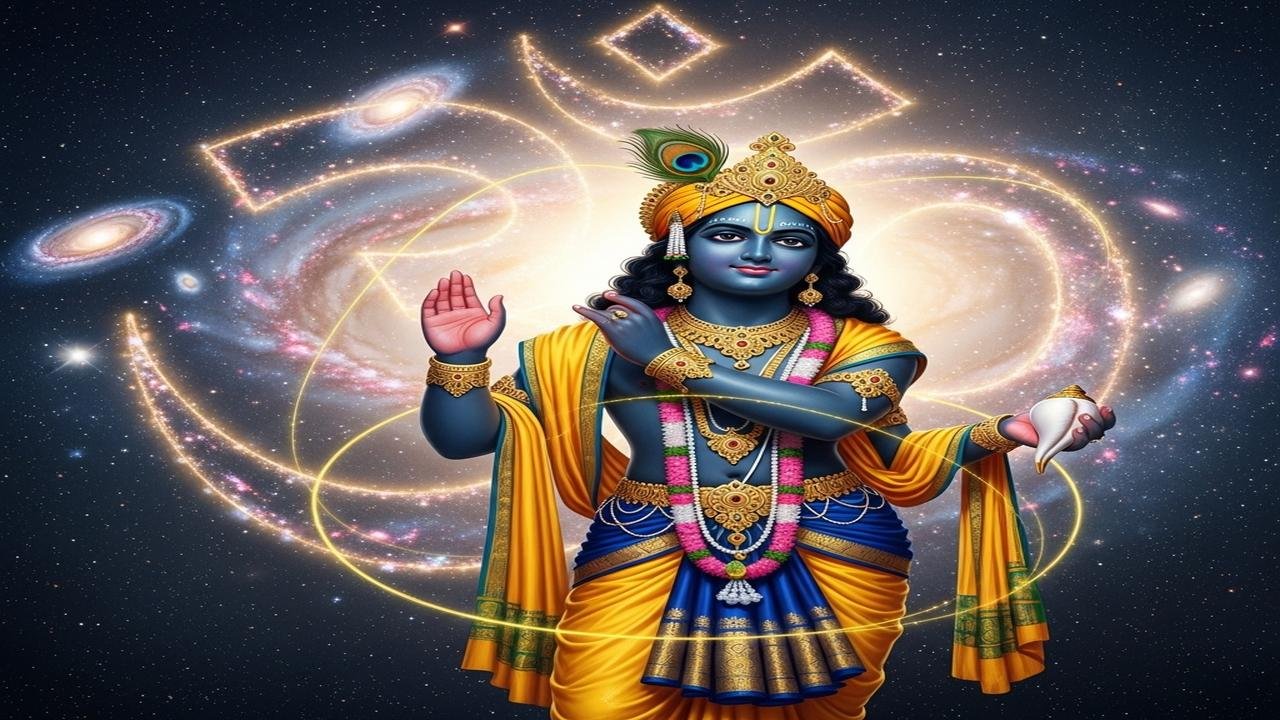
Where the claim appears
The most direct scriptural statement that “Krishna is the source of all creation” appears in the Bhagavad Gītā, the dialogue between Krishna and Arjuna in the Mahābhārata. In chapter 10 Krishna says, aham sarvasya prabhavah — “I am the origin of all” (Gītā 10.8). Earlier and later passages echo and expand the claim: chapter 9 speaks of the Lord as the material and efficient cause of the world (mayādhyakṣena prakṛtiḥ, Gītā 9.4–5), and chapter 11 presents the cosmic form (viśvarūpa) in which Arjuna beholds a universe-filled divinity.
These lines are theological declarations embedded in a poetic-philosophical text. Different readers — commentators, philosophers and religious communities — have read them in different ways, which affects how the phrase “source of all” is understood.
Three ways to read “source”
- Cosmological cause: Krishna as the cause of the universe’s coming-to-be and dissolution. Here “source” is about origination: the deity produces, sustains and withdraws creation.
- Ontological ground: Krishna as the ground of being — the ultimate reality on which everything depends. This is closer to metaphysical claims about what ultimately exists.
- Soteriological source: Krishna as the source of grace, meaning and liberation. From this angle the divine is the originator of spiritual life and salvation, not only physical existence.
How major schools interpret the words
- Advaita Vedānta (Shankara): Interprets statements in the Gītā in the light of an impersonal Brahman — the unchanging ground of reality. Krishna’s “I” can be read as ultimate Brahman or as a teaching device pointing to the Self (ātman). The personal descriptions are often understood as upāya (skillful means).
- Viśiṣṭādvaita (Rāmānuja): Reads Krishna (or Viṣṇu) as the personal supreme Lord, the inner controller and the source of the universe while maintaining a real relationship between God and the world (qualified non-dualism).
- Dvaita (Madhva): Affirms an ontological distinction between God and individual souls; Krishna is supreme and distinct, the original cause of everything.
- Vaiṣṇava bhakti traditions (e.g., Gaudiya): Often emphasize svayam bhagavān — “Krishna as the original God” — reading the Gītā and the Bhāgavata Purāṇa to place Krishna at the centre of cosmic and devotional reality.
- Śaiva and Śākta perspectives: These traditions may reframe the claim within their own theological grammar, identifying the cosmic source with Śiva or Śakti or reading the Gītā text as one among many valid expressions of ultimate reality.
- Smārta and eclectic approaches: Tend to accommodate multiple viewpoints, seeing the divine declarations as expressions of one truth that can be accessed via different deities and practices.
Scripture and context matter
Commentators across centuries treat the Gītā’s claims as part of a wider scriptural and ritual context. Classical commentators — such as Śaṅkara, Rāmānuja and Madhva — engage with the same verses but arrive at different metaphysical conclusions because they read the Gītā alongside other texts, interpretive principles and lived traditions. Devotional poets and temple theologies read Krishna’s statement as both an ontological fact and an invitation to relationship (worship, love, service).
Example passages
- Gītā 10.8 — “ahaṃ sarvasya prabhavah”: “I am the origin of all; from Me everything proceeds.”
- Gītā 9.4–5: Stresses that everything exists by God’s arrangement and that living beings come to be because of divine will and nature (prakṛti — nature).
- Gītā 11: The cosmic form gives Arjuna a visionary experience of a deity who contains and transcends the universe simultaneously.
Practical and devotional implications
When Krishna is understood as the source of all, it shapes ritual, worship and ethics. Devotional practices (puja, kīrtan, reading scripture) become ways to relate to the origin: gratitude, surrender and remembrance of dependence. In temple theology, images and darśana are treated as windows to the source, not mere symbols.
For many devotees, the statement encourages humble recognition that individual effort, social duty (dharma) and moral action occur within a reality that is ultimately sustained by the divine. For philosophers, it raises technical questions about causation, plurality, and the status of the world.
Festivals and practices
- Krishna Janmashtami — celebrating Krishna’s birth — is a major occasion when communities recall the Lord’s cosmic role. Many observe fasts and night vigils; if you fast, take care of your health and consult a physician if you have medical concerns.
- Puja and kīrtan in Vaishnava temples often explicitly praise Krishna as the origin and refuge, while other temples may substitute their own deity as the supreme source.
Contemporary conversations
In modern India and the global scholarly scene, the claim that “Krishna is the source of all” is discussed both as a historical-theological fact and as a living religious truth. Comparative theology notes parallels (e.g., creator-claims in other faiths), while inter-religious dialogue explores how such assertions coexist with pluralism. Academics emphasise textual development and community interpretation; practitioners emphasise lived devotion.
Conclusion
“Krishna is the source of all creation” is a compact scriptural claim with wide philosophical and devotional reach. The Bhagavad Gītā presents it as part of a larger conversation about duty, knowledge and liberation. How one understands “source” depends on one’s interpretive lens — metaphysical, literal, devotional or poetic. Respecting this diversity is important: the statement functions simultaneously as theology, poetry and lived religion across India’s many traditions.
