
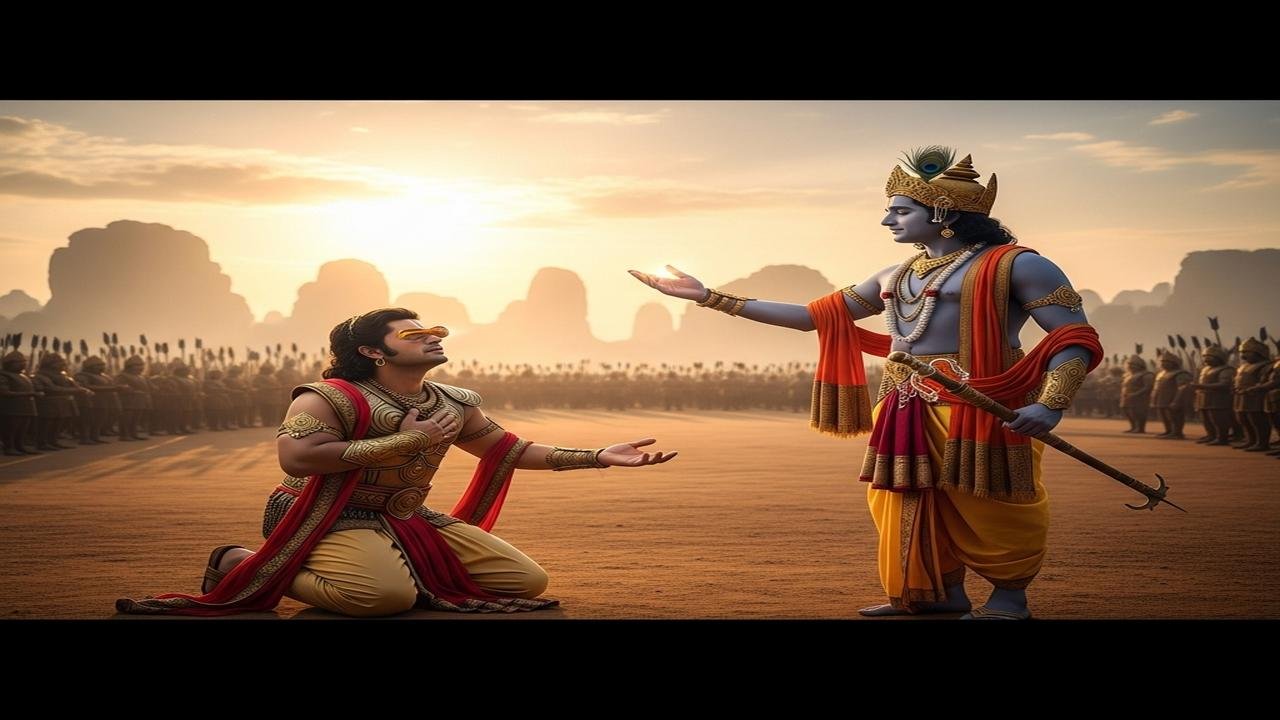
Krishna Grants Arjuna Divine Eyes to See His Universal Form

Background: where this episode appears
The episode of Krishna granting Arjuna divine sight occurs in the Bhagavad Gītā, the spiritual dialogue that forms part of the Mahābhārata. It is contained in Chapter 11, commonly titled Viśvarūpa Darśana-yoga — the yoga of seeing the universal form. The scene follows a long exchange about duty (dharma — ethical duty) and devotion; Arjuna asks to see Krishna’s true, all-encompassing nature before he commits to fighting in the Kurukṣetra war.
The request and the granting: divya cakṣu (divine eye)
Arjuna’s request is explicit: he asks Krishna to reveal His supreme form, beyond ordinary appearance. Krishna responds that this cosmic vision cannot be gained by ordinary sense perception and offers to bestow a special spiritual faculty — divya cakṣu (divine eye) — so Arjuna can behold the universal form directly.
- This exchange is narrated in Chapter 11 of the Gītā; the verses explaining the granting and the subsequent vision occupy roughly verses 8–14 and the remainder of the chapter.
- The phrase “divine eye” is used in several Indic contexts to indicate an inner, transcendent mode of seeing that transcends normal cognitive limits.
What Arjuna sees: the universal form
The description that follows is vivid and filled with poetic, often overwhelming imagery. Krishna’s universal form is portrayed as simultaneously manifold and unitive: innumerable mouths and eyes, many ornaments and weapons, countless divine lights, blazing faces, and endless armies. Time and destruction are present in the vision; Arjuna sees kings, gods, and beings entering Krishna’s mouths, and he perceives the entire cosmos moving as a single, organic whole.
Two points worth noting:
- The text uses paradox and superlative language (multifarious yet one) to convey an experience that exceeds ordinary categories of perception and discourse.
- The vision includes both creation and dissolution — a reminder that the divine form in the Gītā embraces the full cycle of existence, not only beauty or benevolence.
Arjuna’s reaction
Arjuna is awestruck and frightened. He bows, prays, and then asks questions about what he sees; he expresses both devotion and terror. In response, Krishna explains aspects of the vision and reminds Arjuna of his duty. Towards the end of the chapter Krishna withdraws the universal form and returns to his more familiar, four-armed form with which Arjuna is comfortable.
How commentators and traditions read the episode
This chapter is a rich site of interpretation across schools:
- Vaiṣṇava readings (e.g., those following Rāmānuja or later bhakti traditions) tend to emphasise the personal nature of Krishna even in His cosmic display: the universal form reveals the supremacy of Krishna as Bhagavān and inspires devotion.
- Advaita readings (e.g., Śaṅkara) often read the episode as pointing toward the non-dual ground: the multiplicity subsumed in Brahman; the vision can be understood pedagogically, showing the illusory character of separateness.
- Mādhva and other dualist commentators may stress the distinction between Lord and soul while still treating the vision as proof of Krishna’s transcendence and omnipotence.
- Scholars also note literary and ritual parallels: other Indic texts describe “divine vision” episodes, and temple iconography and classical art frequently evoke the Viśvarūpa theme without being literal reproductions of the Gītā text.
Why this episode matters
- It shifts the conversation from ethical instruction to the metaphysical: ethics and action lead to a vision that reveals cosmic order.
- It models a religious pedagogy — humility (Arjuna’s request), teacherly grace (Krishna’s gift), and experiential confirmation (the vision) — important across many living traditions in India.
- It balances fear and devotion: the vision is both terrifying and sanctifying, prompting prayer and renewed commitment to duty.
Living practice, art and ritual echoes
The Viśvarūpa episode resonates in devotional reading, temple art, dance, and drama. Certain festivals and recitations of the Gītā highlight Chapter 11 for its devotional intensity. In painting and sculpture, artists have interpreted the cosmic form in widely varying styles — sometimes emphasizing multiplicity and cosmic scale, sometimes the central personal presence of the Lord.
Note: intense devotional practices, long fasts, or breathwork intended to induce visionary experiences should be undertaken with proper guidance and awareness of one’s health limits.
Conclusion: humility before the ineffable
Krishna’s granting of divine sight to Arjuna is a compact yet profound episode that blends theology, poetics and spiritual pedagogy. Whether read as a literal theophany, a metaphoric instruction, or a visionary allegory, it has shaped religious imagination across traditions. Importantly, commentators and practitioners continue to treat the passage with reverence and interpretive openness — recognizing that claims about “seeing the divine” sit at the intersection of experience, language and belief.
