
Arjuna Sees the Cosmic Form of Krishna

Introduction
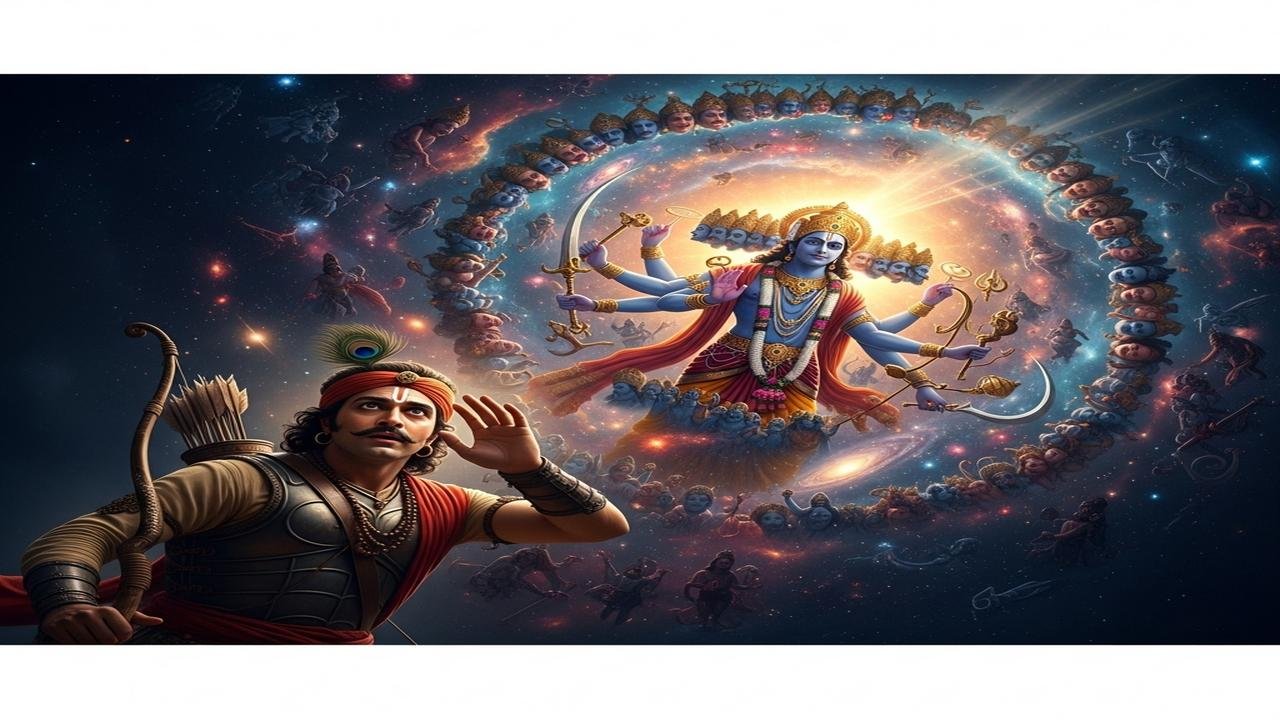
The episode in which Arjuna sees the cosmic form of Krishna is one of the best-known and most debated passages in the Bhagavad Gītā. It appears in Chapter 11, often titled Viśvarūpa-darśana-yoga — the yoga of seeing the universal form — and is embedded in the larger Mahābhārata narrative at the Kurukṣetra battlefield. The scene is presented as both dramatic vision and dense theology: a human hero, confused about his duty, is granted a direct—and terrifying—view of the divine totality.
Context within the epic
At the start of the Kurukṣetra war Arjuna, the Pandava warrior and disciple of Krishna, is overcome with moral doubt about fighting his kin. The Gītā unfolds as Krishna’s instruction to him. In Chapter 11 (Bhagavad Gita, Chapter 11; total 55 verses), Arjuna asks Krishna to reveal his supreme form. Krishna first explains that an ordinary human eye cannot perceive this without special vision. The narrative then shifts to the granting of that faculty and Arjuna’s subsequent experience.
What Arjuna sees
The Gītā describes an overwhelming, multilayered vision. The account mixes cosmic imagery, battle motifs and religious symbolism. Key features commonly noted are:
- Multiplicity and simultaneity: Krishna’s form contains countless mouths, eyes, and wonders; whole universes appear simultaneously.
- Light and fire: The form blazes like the rising sun, radiant beyond the ordinary world.
- All beings and timelines: Deities, sages, mortal heroes and all living things appear within the form; past, present and future are suggested together.
- Destruction and preservation: The vision includes the swallowing or consuming of warriors and the sense that the world’s processes are being carried out by the divine will.
- The divine proclamation: At a crucial moment Krishna declares a cosmic role: “I am Time (kāla), the destroyer of worlds,” a line that anchors the vision in themes of mortality and cosmic law.
Verses in the middle of Chapter 11 (roughly verses 4–30 in most editions) describe the visual content; verse 32 contains the famous proclamation about time. The experience ends with Arjuna’s prayer, humility and request that Krishna return to a calmer, familiar form.
How scholars and traditions read the episode
Interpretations vary across schools and commentators, and it is important to be careful and modest when summarising them.
- Bhakti and Vaiṣṇava readings: Many Vaiṣṇava commentators and devotional traditions take the vision as literal revelation of Krishna’s supreme personhood. For them the episode is the apex of divine grace: God grants the devotee a direct, immediate vision to strengthen devotion and surrender.
- Vedāntic and Advaita perspectives: Advaita interpreters (e.g., those following Adi Śaṅkara’s approach) may emphasise the vision as a symbolic disclosure of Brahman manifesting the world; the cosmic form points to the non-dual substratum rather than to a theistic personality alone.
- Ethical and existential readings: Some modern commentators read the episode as a way to resolve Arjuna’s moral perplexity: confronting the vastness of cosmic order reframes personal duty (dharma — ethical duty) and the reality of life and death.
- Historico-literary approaches: Scholars who treat the Gītā as layered scripture note how the vision scene may collect older and newer themes—royal legitimacy, sacrificial imagery, apocalyptic time—into a single theological moment.
Key motifs and what they mean
- Divine vision or divya-cakṣu (divine eye): The Gītā emphasises that seeing the viśvarūpa requires a special gift from the divine. Commentators see this as underscoring the role of grace in spiritual knowledge.
- Time and inevitability: Krishna’s self-identification with time highlights the moral seriousness of action and the limits of individual control.
- Synthesis of roles: The cosmic form brings together creator, preserver and destroyer dimensions, making it a theologically capacious image that different sects can read in their own terms.
Art, ritual and living practice
The viśvarūpa vision has a long afterlife in Indian art and ritual. Miniature paintings, temple sculpture and modern prints attempt to render the multiplicity of the form—sometimes with many heads and arms, sometimes more abstractly as radiant light. In devotional recitation and in commentarial study, Chapter 11 is often read aloud during festivals and teaching sessions. Some temples display iconographic panels that recall the universal aspect of the deity. Interpretations vary across regions and sects: what is central for one community may be peripheral for another.
Why the episode matters today
For many readers the scene addresses perennial human puzzles: how to act in a world of suffering, how to reconcile finitude with transcendence, and how devotion and knowledge relate. The image invites humility—Arjuna collapses from awe and fear—and at the same time calls for responsible action. Different schools emphasize different takeaways: surrender (bhakti), insight into the ultimate reality (jñāna), or a renewed sense of duty (karma). That plurality is part of the Gītā’s enduring power.
Notes on practice and caution
The Gītā’s vision is ultimately presented as a gift rather than a technique. Some modern spiritual practices draw on its imagery in meditation or breath-based exercises; if you try breathwork, fasting or intensive meditation, do so carefully and under proper guidance, especially if you have health concerns.
In summary: Arjuna’s seeing of Krishna’s cosmic form is a concentrated scriptural moment where poetry, theology and moral urgency meet. It has inspired devotional intimacy and metaphysical debate across centuries, and it continues to be read and re-read by those seeking to understand the relationship between the self, duty and the vastness that the Gītā calls the divine.
