
Arjuna Sees Krishna Devouring the Warriors of Both Armies

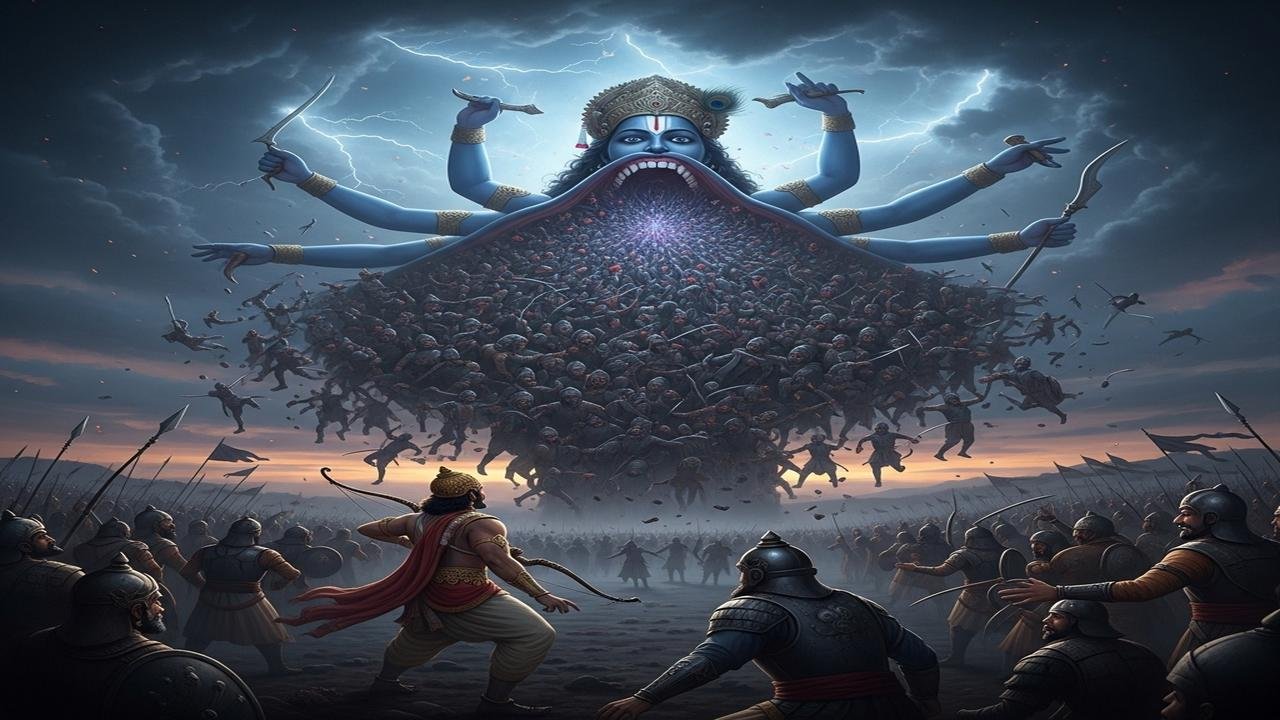
Context on the battlefield
The scene takes place on the plains of Kurukṣetra in the Mahābhārata, during the spiritual dialogue called the Bhagavad Gītā. Arjuna, the Pandava warrior, has been overwhelmed by doubt about fighting his kinsmen and teachers. In response, Krishna—his charioteer and teacher—expounds teachings on duty (dharma), action, devotion and knowledge across earlier chapters. In Chapter 11, at Arjuna’s request, Krishna grants him divine vision (divya cakṣu) so he can see the Lord’s universal form (viśvarūpa).
What Arjuna sees
- Arjuna reports a vision of a colossal, many‑faced form containing gods, sages, and the whole cosmos: myriad mouths, eyes, heavenly ornaments, and countless weapons (Bhagavad Gītā 11.16–24, 11.25–30).
- He describes multicoloured lights and hosts of celestial beings moving into that form; the universe appears contained within the Lord, yet dynamically alive.
- Most strikingly, Arjuna sees great warriors from both armies rushing into the Lord’s blazing mouths and being devoured; he perceives the Lord as the power that consumes fighters and worlds alike (cf. 11.25–26, 11.32).
- Krishna identifies himself as kāla—Time or Death—“appointed for the destruction of worlds” and tells Arjuna to rise and fight, saying that these events are already ordained (11.32–33).
Textual citations and immediate effect
The core passages are in Bhagavad Gītā, Chapter 11: the granting of divine sight (11.8), Arjuna’s vivid description (11.16–30), Krishna’s declaration as Time (11.32), and the instruction that Arjuna must carry out his role (11.33–34). After the vision, Arjuna’s earlier paralysis changes to resolute acceptance of his duty as a warrior bound by dharma.
How commentators read the scene
- Vaiṣṇava readings (e.g., Rāmānuja, Madhva): Stress the personal nature of God. For Rāmānuja (11th–12th c.) and later Vaiṣṇava traditions, the viśvarūpa confirms Krishna’s supremacy and justifies Arjuna’s role as an instrument of divine will. The vision is devotional; Arjuna’s surrender becomes paradigmatic for bhakti.
- Advaita readings (Śaṅkara, ca. 8th c.): Often underline a teaching about the one reality behind forms. Śaṅkara tends to read the vision as a Saguna (with attributes) manifestation pointing toward the Nirguna (attribute‑less) Brahman; the cosmic form is a teaching device, not a literal catalogue of deity‑consumption.
- Ethical and pragmatic readings: Modern scholars and ethicists highlight the tension in a passage that seems to spectacles of divine violence. Many caution against reading the episode as blanket sanction for violence; instead, they place it in a narrative and soteriological frame: the vision’s purpose is to resolve Arjuna’s moral confusion so he can act in accord with a specific conception of duty.
- Other traditional lenses: Śaiva and Śākta readers may interpret the cosmic, consuming aspect in terms of Śiva’s destructive aspect or the all‑consuming power of Śakti; Smārta commentators integrate such readings with pan‑Hindu monism.
Symbolic meanings often emphasised
- Time and impermanence: Krishna’s self‑identification as kāla (Time) points to the inexorable processes of change and death that engulf all forms.
- Unity of the manifest and unmanifest: The viśvarūpa shows that the many are expressions of a single reality that is both immanent and transcendent.
- Role of the individual: Arjuna’s seeing and subsequent surrender dramatise the spiritual shift from personal reluctance to conscious participation in a duty understood as part of a larger order.
- Ritual and sacrificial imagery: Some interpreters see the imagery of devouring and fire as linked to Vedic sacrificial metaphors—the world as offering, the Lord as recipient—recasting war in sacrificial language while raising moral questions about such transfers of meaning.
Iconography and devotional practice
The viśvarūpa has inspired art and ritual. In some Vaishnava settings, the universal form is depicted with many heads and arms, and in festival retellings the chapter is recited to highlight Krishna’s all‑embracing nature. Temple sculpture and miniature painting from different regions show wide variation; some emphasise the terrifying, consuming aspect, others the luminous, protective aspect—reflecting the plurality of devotional responses.
Ethical cautions and contemporary readings
Readers should be careful about interpreting the episode as an unqualified justification for violence. Most traditional commentators and modern scholars insist on reading the vision within its narrative and theological context: it is meant to resolve a particular moral crisis and to articulate a vision of cosmic order, not to provide a general political doctrine for aggression. The passage invites reflection about duty, responsibility and the limits of human judgement.
Why the episode matters
Arjuna’s seeing of Krishna devouring warriors is one of the Gītā’s most dramatic moments. It crystallises several of the text’s central themes—divine immanence and transcendence, the reality of death and impermanence, and the call to act from clarity rather than confusion. Across traditions, the vision is read as a test, a revelation, and a turning point: it transforms Arjuna from a conflicted man into a disciple ready to carry out his duty in the light of a broader, if deeply challenging, theological perspective.
Further reading and study
- For close study, consult Bhagavad Gītā Chapter 11 (translations and verse commentaries vary).
- Compare commentaries by Śaṅkara (Advaita), Rāmānuja (Viśiṣṭādvaita) and Madhva (Dvaita) to see how theological starting points shape interpretation.
- Look at art history and temple traditions for how the viśvarūpa has been visualised regionally.
Whatever one’s school, the episode invites repeated reflection rather than quick conclusions: it presses readers to weigh devotion, knowledge and ethical action in a world where life and death are intimately linked.
