
Krishna Declares He Is Time, the Destroyer of Worlds

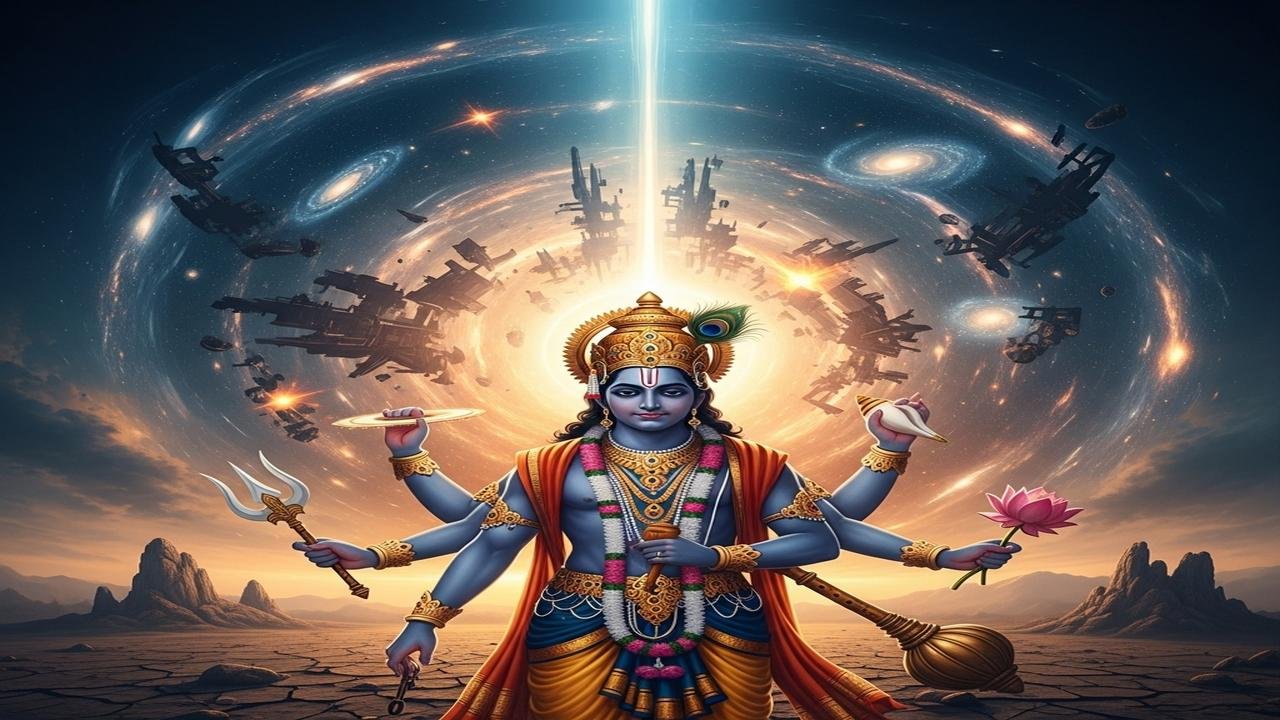
Scene: Kurukṣetra and the Universal Vision
In the middle of the Bhagavad Gītā (chapter 11), Krishna grants Arjuna a theophany — the vision of his universal form, the viśvarūpa. At one moment in that vision Krishna declares, “kālo’smi loka-kṣhaya-kṛt pravṛddho” (Bhagavad Gītā 11.32). In common English renderings this is often given as “I am Time (kāla), the great destroyer of worlds.” The line occurs on the battlefield of Kurukṣetra, in an urgent moral and metaphysical context: a warrior torn between duty and compassion is shown the cosmic order that underpins action and consequence.
What does “kāla” mean here?
The Sanskrit word kāla is polysemous. On first facing it in this verse, note the primary shades:
- kāla — time: chronological time, the passage and cycles that govern creation and decay.
- kāla — death or destroyer: personified as an agent who brings endings; in some contexts translated as “Death.”
- Mahākāla — great Time: a title used in Śaiva and popular practice to denote a powerful, sometimes terrifying, aspect of the divine who controls limits and endings.
In 11.32 the grammar and context present Krishna as identifying with the active principle that brings about dissolution — not merely an abstract clock but a cosmic power that enacts endings within the world-order.
Literal text and a sampling of translations
Transliteration: kālo’smi loka-kṣhaya-kṛt pravṛddho lokān samāhartum iha pravṛttaḥ (Gītā 11.32).
- “I am Time, the mighty force that destroys the worlds; I have come here to annihilate.” — common literal sense.
- Some translators prefer “I am Death” or “I am the principle of dissolution,” emphasising the anthropomorphic agent.
- Commentators sometimes render it as “I am the force of historical change,” to stress impersonal, law-like aspects.
How different traditions read the line
Interpretation depends on theological starting-points. Below are respectful summaries of major readings.
- Vaiṣṇava readings: Many Vaiṣṇava commentators (classical and modern) take Krishna’s self-identification as assertion of his supremacy — the Supreme Being transcending and controlling time. Time is seen as one of his energies (śaktis), a sovereign function by which he enacts cosmic order and justice.
- Advaita and Smārta readings: In Advaita Vedānta commentaries (e.g., Adi Śaṅkarācārya’s school), Krishna’s declaration is often read metaphysically: kāla can be the empirical principle of change within māyā (illusion); the utterance is instructive to the seeker about the transient, cyclical nature of phenomena.
- Śaiva and Śākta perspectives: In Śaiva traditions, the epithet Mahākāla attaches to Śiva; some readings see a point of convergence — the destructive aspect of the divine is recognised across deities. Śākta readings may relate the statement to fierce goddesses (e.g., Kālī) who enact dissolution as part of creative renewal.
- Modern and literary readings: Contemporary interpreters (philosophical, poetic, and scholarly) variably stress existential, historical, or psychological meanings: a prophetic insistence on the inevitability of social change; a stark image of mortality; or a symbolic portrayal of conditions that force ethical choices.
Theological and ethical implications
Krishna’s declaration is compact but dense in consequence:
- Sovereignty over life and history: If the divine identifies with the principle that brings endings, that implies a theistic claim about ultimate control of cosmological cycles, including birth and death, rise and fall of kingdoms.
- Mandate for action: In the Gītā’s narrative, the utterance supports Krishna’s insistence that Arjuna perform his duty (dharma — ethical duty) rather than be paralysed by attachment. The vision reframes individual suffering within cosmic process.
- Ethical warning: Readers across centuries have taken the line as a stern reminder that human afflictions and structures are transient; it can be read as a call to face moral responsibility without illusion.
- Not an endorsement of violence: Historically sensitive readers note that the Gītā’s battlefield scene is specific; claiming Krishna condones all violence would be a category error. Many commentators emphasize the conditional nature of the injunction and the larger philosophical teaching on detached, righteous action.
Iconography and living traditions
The theme of divine time and destruction appears widely in ritual and art:
- Śiva as Mahākāla is prominent at Ujjain and in many temple traditions; here the destructive aspect is also protective and transformative.
- Kālī and Bhairava in Śākta and local cults embody fierce energies that end ignorance and disorder; festival practices invoke them as guardians of cosmic order.
- Vaiṣṇava devotional practice often reads the Gītā line as confirmation that Krishna’s will governs cosmic outcomes; it appears in discourses, kathā, and bhajans, where it functions as theological affirmation rather than ritual literalism.
Reading the verse today
For an informed contemporary reader in India, the verse can be approached on several levels: historical-literary (a dramatic moment in an epic), metaphysical (a statement about the nature of time and change), ethical (a call to responsible action), and devotional (a claim about divine sovereignty). Each school provides resources to balance awe, humility and moral responsibility.
Conclusion: plurality and prudence
“I am Time, the destroyer of worlds” is a theologically weighty and polyvalent line. Its force lies in compressing cosmology, ethics, and theology into a single, dramatic assertion. Different traditions—Vaiṣṇava, Śaiva, Smārta, Śākta and various philosophical commentators—bring rich, sometimes divergent, readings. A respectful study of the Gītā passage (chapter 11) alongside classical commentaries invites a fuller sense of why the line continues to provoke reflection: it confronts the human condition of finitude while pointing to how communities have sought meaning, duty and devotion in the face of endings.
