
Krishna Returns to His Four-Armed and Human Form

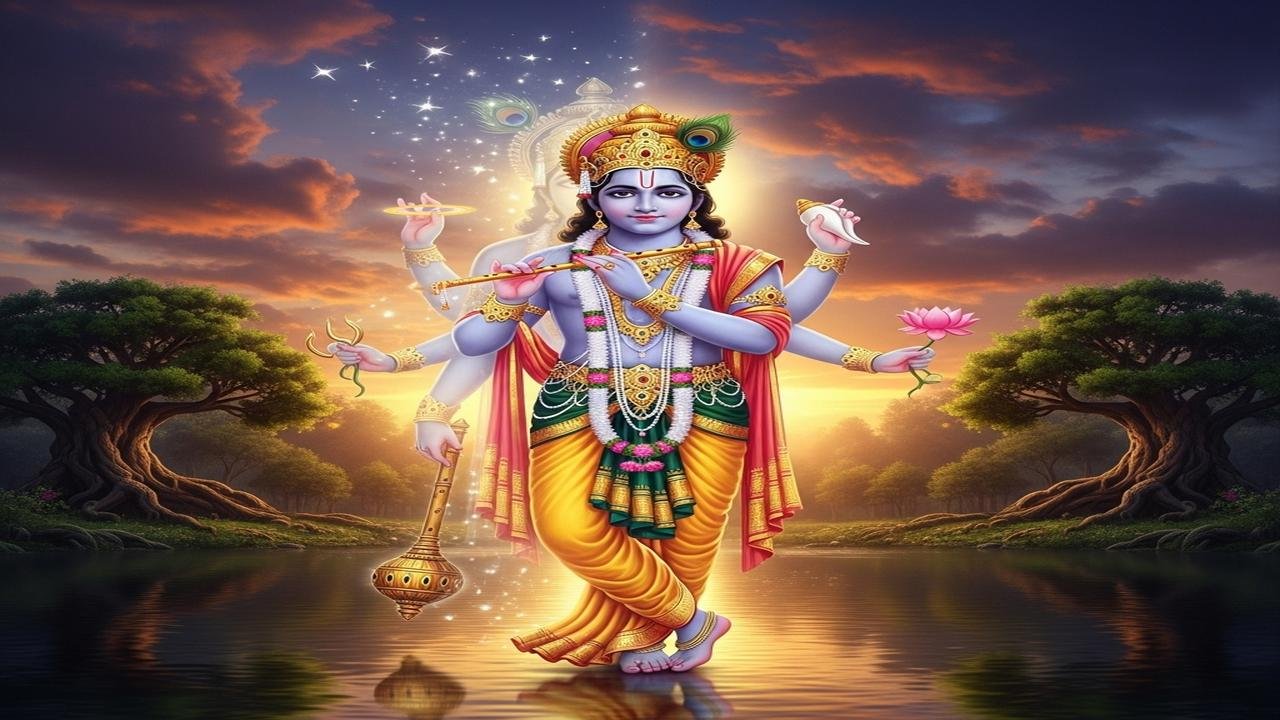
What devotees mean by “Krishna returns to his four‑armed and human form”
The phrase captures a long-standing motif in Hindu thought and worship: Krishna appears both as an intimate, two‑armed cowherd — the human or lila (divine play) form — and as a more transcendent, often four‑armed Vishnu or Narayana form that bears conch, discus, mace and lotus. Different texts and traditions narrate occasions when the Lord shows his cosmic aspects or resumes a fuller, four‑armed manifestation. The motif points to a theological tension that devotees and philosophers have lived with for centuries: closeness and play versus majesty and omnipotence.
Scriptural glimpses
Several scriptural layers feed this idea. The Bhagavad Gita (chapter 11) records Arjuna’s vision of the Vishvarupa — a many‑armed, universal form of Krishna — which emphasises the Lord’s cosmic, all‑embracing nature. The Purāṇas, especially the Bhāgavata Purāṇa (Srimad Bhagavatam), describe Krishna’s childhood and youth in two‑armed, relational modes (flute‑playing cowherd, lover of the gopīs), while also recounting episodes where he manifests expansive, supernatural powers and divine forms.
Vedic and Purāṇic material treat avatāra (incarnation) in different ways: sometimes the avatāra contracts divine opulence for lila; at other moments the same avatāra reveals his transcendence. Commentators and regional narratives vary about when and why the “return” to a four‑armed (or otherwise cosmic) aspect happens.
Iconography and temple practice
Visually the two modes are easy to distinguish:
- Two‑armed Krishna: typically shown with a flute (bansuri), peacock feather, cowherd dress — emphasis on intimacy and personal devotion.
- Four‑armed Vishnu/Narayana: holds the shankha (conch), chakra (discus), gada (mace) and padma (lotus) — emphasis on sovereignty, dharma (ethical duty) and cosmic rule.
Many temple traditions keep these images distinct: some shrines are dedicated to Krishna as a child or lover (two‑armed), while other temples preserve the chaturbhuja (four‑armed) form of Vishnu. In festival practice, murtis (icons) may be clothed, ornamented or ritualistically revealed in ways that foreground either intimacy or transcendence. Regional customs and historical developments determine how readily a community moves between the two emphases.
How different schools read the change of form
Interpretations are diverse and respectful of one another’s concerns.
- Gaudiya and other devotion‑centred Vaishnava readings: emphasise the two‑armed Krishna in Vrindavan as the original, most intimate form (called svayam bhagavan — the Lord himself). The cosmic forms are seen as expansions taken for specific purposes.
- Classical Smarta and Bhagavata views: treat Krishna as one expression of Narayana/Vishnu; the four‑armed form expresses the Lord’s function as sustainer. The human play does not negate divinity but shows how the divine chooses closeness.
- Advaita and nondual commentaries: sometimes read visions like the Vishvarupa as symbolic disclosures of the one reality behind apparent forms; practices and images are skillful means (upaya) for realising the Ultimate.
- Other readings (Śaiva, Śākta regional traditions): often accept the polyvalence of the divine. They may place Krishna’s transformations within a broader ritual or mythic economy where deities assume roles according to context.
Scholars note that commentators such as Ramanuja, Madhva and later bhakti teachers offered distinct exegeses of verses describing cosmic revelation; their differences are interpretive rather than merely polemical.
Why the “return” matters theologically
There are at least three reasons communities emphasise the transition between forms:
- Relational access: The two‑armed form makes the divine approachable for bhakti (devotional love). Intimacy with Krishna allows personal, emotional devotion.
- Cosmic order: The four‑armed form affirms the Lord’s role in sustaining dharma and the cosmos; it reassures devotees that love does not mean lawlessness.
- Ritual completeness: Alternating emphasis allows ritual life to express both surrender and reverence, prayer and awe. Theology and liturgy work together.
Practice and lived devotion
Devotees use the two modes of Krishna in different practices:
- Meditation on the two‑armed Krishna to cultivate intimacy and longing.
- Invoking the four‑armed form when asking for protection, guidance, or the strength to uphold dharma.
- Reciting Bhagavad Gita chapter 11 or portions of the Bhāgavata Purāṇa to encounter the Lord’s cosmic aspect — often as part of communal reading or festival narrations.
Caution: certain devotional practices involve sustained fasting or breathwork; consult a medical professional if you have health concerns before undertaking them.
Contemporary reflections
In modern devotional life the two modes continue to coexist. Pilgrims may visit a shrine where Krishna is worshipped as a child, then travel to a temple where he is venerated as Vishnu with four arms. Popular literature, music and visual arts trade in both images: the flute and the chakra are not opposed but complementary ways of speaking about the same divine mystery.
Scholars and devotees alike often emphasise humility about literal claims. Whether one reads episodes of “return” as historical occurrences, visionary experiences, or theological metaphors depends on one’s tradition and temperament. Most traditions agree on the practical point: both modes are meant to draw humans into ethical living, devotion and the memory of the divine.
Closing note
The image of Krishna shifting between a human, two‑armed persona and a four‑armed, cosmic presence is a powerful symbol—one that balances intimacy and awe, play and principle. It remains both a subject of careful exegesis in the commentarial tradition and a living pattern of devotion in temples, homes and festivals across India, where people continue to encounter the divine in forms that meet differing needs of heart and reason.
