
Krishna Explains the Inverted Tree of Material Existence

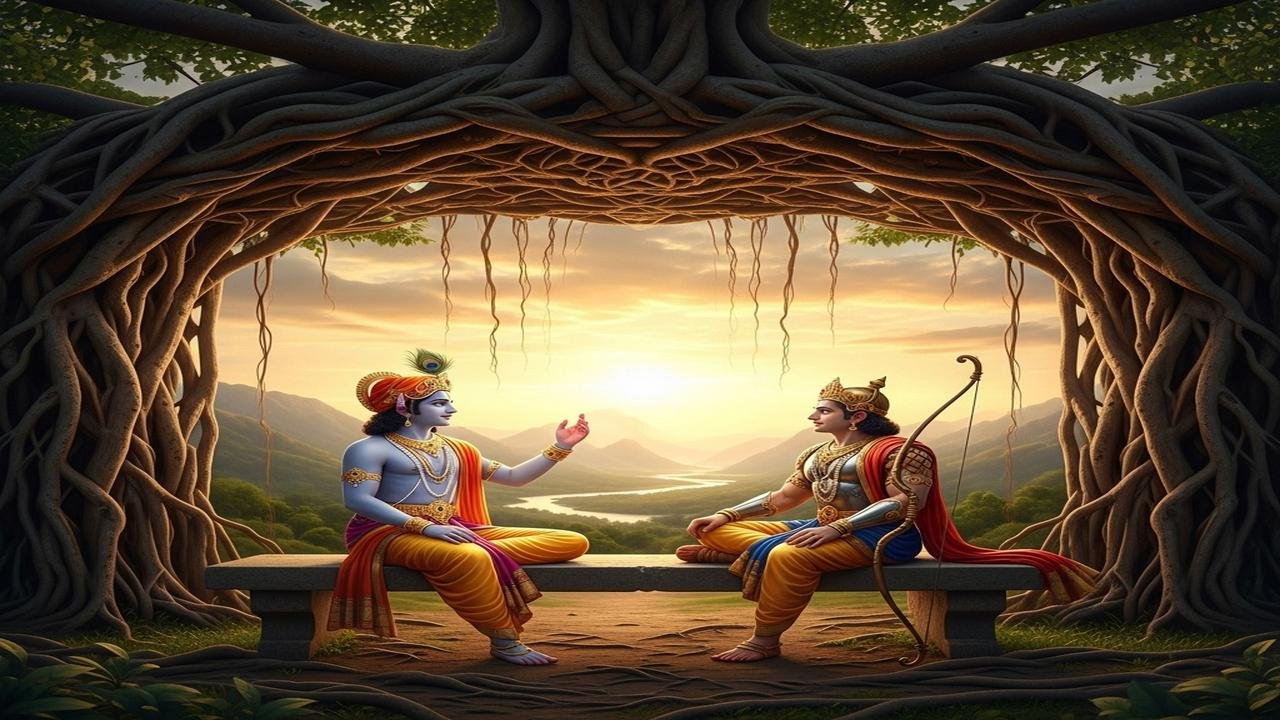
Krishna’s image: the inverted tree in the Bhagavad Gītā
In the Bhagavad Gītā (chapter 15, especially verses 1–4), Krishna presents an arresting image: the aśvattha — commonly translated as the banyan or fig tree — whose roots point upward and branches spread downward. He uses this inverted tree as a compact metaphor for material existence: an origin above, a profusion of life below, and a single person or principle that stands apart. The short passage has generated centuries of philosophical commentary because it draws together ontology (what exists), cosmology (how the world is ordered) and soteriology (how liberation is achieved).
What the Gītā actually points to
Krishna says the tree’s roots are upward — anchored in the unchanging reality — while its branches grow down into the world of living beings. The leaves, the text says, are the Vedas. One who truly knows this tree, Krishna adds, is a knower of the Vedas. The description then distinguishes what is imperishable from what is perishable and locates the supreme person (the puruṣottama) as beyond both.
Plain meanings to keep in mind
- Upward roots: the source or ground of being (often identified with Brahman, the Absolute, or the divine source).
- Downward branches: the manifold world of birth, death and change (the realm of prakṛti — nature or materiality).
- Leaves as the Vedas: scriptural knowledge is part of the worldly tree; it can point to truth but also get caught up in the tree’s life.
- Puruṣottama: a transcendental person who is distinct from both unchanging reality and mutable nature, according to the Gītā’s language.
Symbolic layers: how commentators read the image
The inverted-tree image allows several overlapping readings rather than a single literal meaning.
Metaphysical: source and manifestation
- Many classical commentators read the image as a map of how the Absolute (root) expresses itself into the cosmos (branches), keeping open a tension between unity and diversity.
- Some read the “root above” as Brahman or the supreme field that nourishes all forms, while the branches are the evolutionary play of prakṛti.
Epistemological: Vedas and leaves
- The Gītā’s claim that the leaves are the Vedas is often taken to mean: scriptural teachings grow from the same cosmic life and are useful, but reading alone does not uproot attachment.
- Thus knowledge (jñāna) must be paired with discernment and detachment to reach the root.
Ethical and soteriological: cutting and liberation
- The Gītā goes on to advise that a wise person should “cut down” this tree with detachment and take refuge in the supreme person. This has been read as practical counsel for cultivating dispassion (vairāgya), restraint, and inner discrimination.
- Different traditions translate “cutting” into their methods: the ascetic’s renunciation, the yogin’s self-control, or the devotee’s surrender.
How different schools interpret the image
- Advaita (Shankaracharya): the world is ultimately māyā; the tree is appearance rooted in Brahman. Liberation is non-dual knowledge that recognizes the root as one’s own Self.
- Viśiṣṭādvaita (Rāmānuja): the tree shows real distinction within a unified whole — nature and soul are real modes of the one Brahman; devotion and qualified knowledge lead to communion with the supreme.
- Dvaita (Madhva) and dualist schools: emphasize the distinction between the eternal Lord and the mutable world; the image points to dependence on God and the necessity of divine grace.
- Bhakti/Gaudiya readings: stress the supreme personhood of Krishna who is beyond the tree; cutting the tree is achieved through loving surrender (bhakti), not mere intellectual effort.
- Śaiva and Śākta perspectives: may reinterpret the root-and-branch symbolism through their own metaphysics (with Śakti or Śiva as the ultimate ground), highlighting energy and embodiment differently from Vedānta readings.
Practical implications for seekers
The inverted-tree image is not merely abstract; it becomes a guide for practice.
- Discrimination and detachment: cultivate discernment between what is transient (branches, fruits) and what is enduring (the root). That means training attention away from compulsive identification with passing roles and sensations.
- Scripture and discipline: study sacred texts (the leaves) so they serve as tools rather than fuels for egoic attachment.
- Paths differ: some traditions recommend contemplative renunciation and inner asceticism; others recommend active devotion and ethical living as the means to “cut” the ties of the tree.
- Health caution: austerities and extensive breath practices should be undertaken responsibly and, where needed, under qualified guidance.
Why the image endures
The inverted tree is compact, memorable and flexible. It captures two persistent intuitions in Indian thought: that the world appears as a manifold because of an underlying ground, and that liberation requires a reversal of ordinary orientation — turning attention back to the root rather than being lost in the branches. That reversal can be expressed as jñāna (knowledge), tapas (discipline), or bhakti (devotion), and different traditions legitimately emphasise different routes.
Keeping interpretive humility
When reading Krishna’s image, it helps to hold several points lightly: the Gītā gives a metaphor, not a scientific description; commentators bring their own doctrinal lenses; and contemporary seekers may draw practical benefit from the metaphor without forcing it into a single systematic scheme. Across schools, the inverted tree remains a shared, evocative way to think about dependence and freedom: where you look — at the branches or for the roots — shapes how you live and where you aim to arrive.
