
Sanjaya Describes His Vision of Krishna and Arjuna

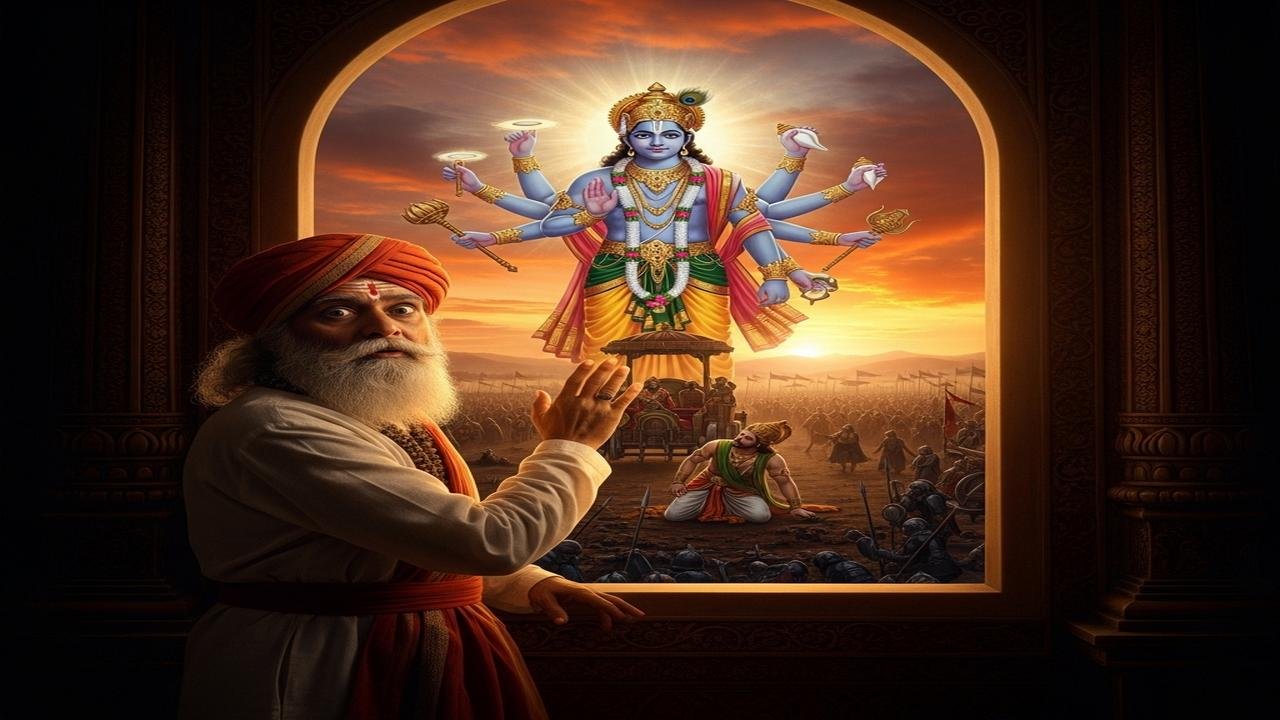
Setting the scene: Sanjaya as witness and narrator
In the Mahābhārata’s Bhīṣma Parva, the Bhagavad Gītā is framed as a report: the blind king Dhṛtarāṣṭra asks what happened on the battlefield of Kurukṣetra, and Sanjaya — his charioteer and counsellor — replies with a detailed account. Sanjaya is said to have been granted divya-dṛṣṭi — “divine sight” — by the sage Vyāsa, which allows him to see events at a distance and to narrate dialogues and visions otherwise inaccessible to ordinary senses. That framing makes Sanjaya both an eyewitness and a literary conduit: his narration shapes how later readers meet Krishna and Arjuna.
What Sanjaya describes
Sanjaya recounts several layers of the encounter between Krishna and Arjuna. First comes the immediate crisis: Arjuna’s moral confusion about fighting his kin and friends, expressed in the opening chapter. Krishna responds across eighteen chapters with teachings that range from practical action to metaphysics. Within that exchange is a pivotal moment — the cosmic or universal form, the viśvarūpa — which is chapter 11 in most recensions. Arjuna asks to see Krishna’s divine form; Krishna grants him the vision and then returns to his human aspect. Sanjaya relays both the intimate dialogue and the spectacle of the vision to Dhṛtarāṣṭra.
Key textual details
- Location in the epic: Bhagavad Gītā appears in the Bhīṣma Parva of the Mahābhārata and is conventionally 700 verses divided into 18 chapters.
- Framing device: The poem begins and ends with Dhṛtarāṣṭra’s question and Sanjaya’s report, making Sanjaya the frame narrator.
- The cosmic vision: The encounter known as the viśvarūpa-darśana is generally placed in chapter 11, where a single stanza states that Arjuna was given divine eyes to behold the form.
How Sanjaya tells it — style and emphasis
Sanjaya’s narration is striking for its combination of clinical detail and devotional awe. He records dialogue, names, and battlefield movements in a way that gives the listener a clear sense of events, yet he also reports moments of wonder — the shining form, Arjuna’s trembling, the cosmic vision’s terrible radiance. This dual register supports two functions: to inform the sceptical Dhṛtarāṣṭra and to evoke the spiritual intensity of the scene for a religiously attentive audience.
Interpretive range: literal, symbolic, and theological readings
Commentators across traditions read Sanjaya’s account differently. Some medieval and modern commentators treat his report as literal: Sanjaya truly saw and accurately described Krishna’s supernatural form and Arjuna’s transformed perception. Classical Advaita interpreters, following Ādi Śaṅkarācārya, often read the viśvarūpa as a revelation of Brahman’s unmanifest and manifest unity — an ontological disclosure pointing to the ultimate reality behind names and forms. Vaiṣṇava commentators emphasise the personal devotion (bhakti) aspect: the vision confirms Krishna’s supremacy and invites surrender. Dvaita readings may stress the distinctiveness of the Lord and the believer. Gītā exegesis therefore ranges from metaphysical to devotional to ethical emphases.
What scholars note about Sanjaya’s role
- Sanjaya functions as a narrative witness whose authority depends on divine aid; without Vyāsa’s gift his account would be impossible.
- The frame invites the reader to inhabit Dhṛtarāṣṭra’s position: to hear, to judge, and perhaps to repent — a didactic move common in classical epics.
- Sanjaya’s calm reporting also prevents the scene from collapsing into mere spectacle; he keeps the moral and philosophical thrust in view.
Significance for practice and devotion
For many readers and communities, Sanjaya’s narration does more than recount an event: it models the attentive listener. The Gītā’s teaching arrives not as abstract theory but as counsel enacted and witnessed in a crisis. Different traditions draw different practical lessons — ethical action (karma), devotional surrender (bhakti), or discriminating knowledge (jñāna) — and they use Sanjaya’s report to situate those lessons inside a living story. The image of Krishna as charioteer (sārathi) and of Arjuna as the perplexed seeker remains potent in ritual, art, and teaching across Vaishnava, Smārta, and other communities.
Notes of caution and humility
Scholars warn against overliteralising any single reading. The Mahābhārata is a composite epic with layers of oral and written growth; the Gītā itself has been subject to multiple editorial traditions. So while Sanjaya’s report is authoritative within the text, modern readers should remain aware that interpretation has always been plural. Readers from different sampradāyas (traditions) will continue to hear different lessons, and respectful pluralism has long been part of the Indian interpretive landscape.
Closing reflection
Sanjaya’s narration offers a bridge: between the battlefield and the king; between the human crisis of duty and the metaphysical answers Krishna gives; between historical story and spiritual teaching. Whether one emphasises the literal wonder of the viśvarūpa, its symbolic depth, or its devotional power, Sanjaya’s calm, attentive voice remains central. He invites every listener — scholar, pilgrim, or curious reader — to witness, reflect, and decide how the vision will shape their own understanding of dharma, devotion, and knowledge.
