
Arjuna Acknowledges Krishna as the Supreme Personality

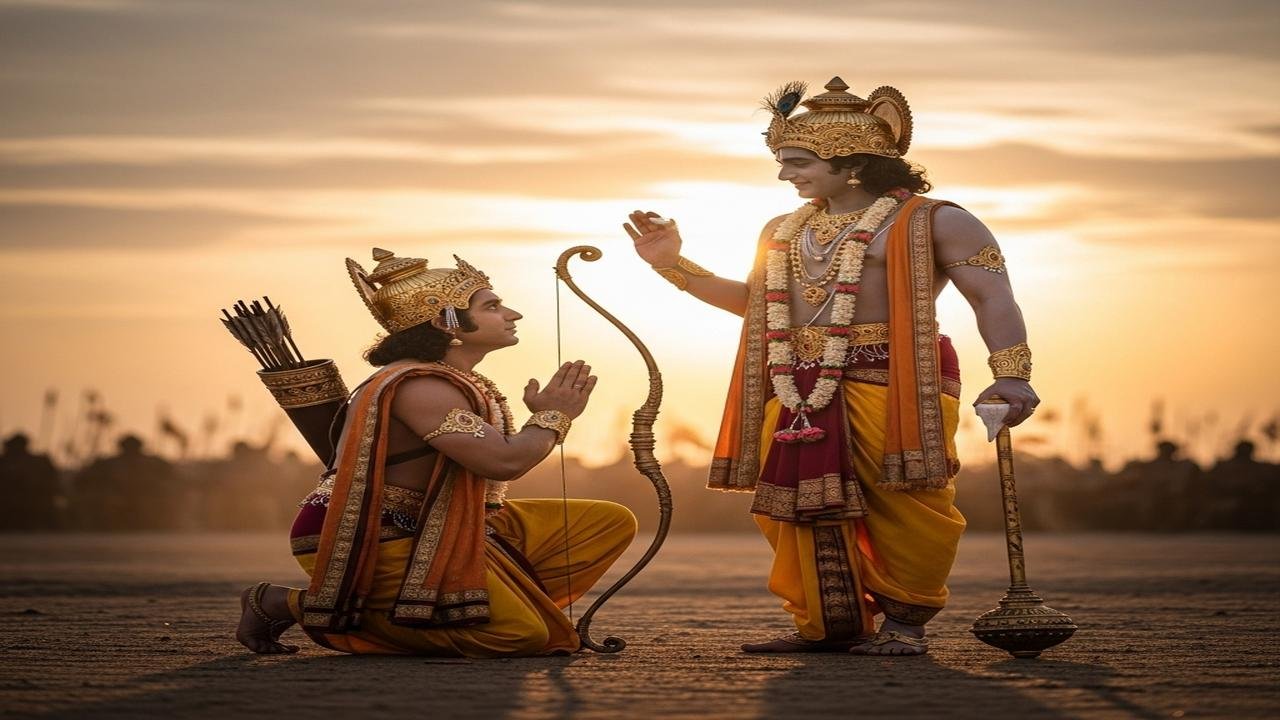
What happens when Arjuna sees Krishna as the Supreme Personality
On the battlefield of Kurukṣetra, the Bhagavad Gītā frames a striking moment in which Arjuna, a grieving and confused warrior prince, asks his charioteer Krishna to reveal his true nature. Krishna responds by withdrawing his ordinary human form and showing Arjuna a cosmic, many‑faced vision — the viśvarūpa or universal form. In that vision Arjuna recognises Krishna not merely as a friend and guide, but as the supreme Divine Person (often rendered in English as “Supreme Personality of Godhead”), an all‑encompassing reality who both manifests and transcends the universe.
The scene: from moral dilemma to theophany
At the start of the Gītā, Arjuna is paralysed by the prospect of fighting kinsmen and teachers. He raises questions about dharma — ethical duty — and the right course of action. Krishna’s instruction moves across several registers: philosophical teaching, ethical guidance and, at Arjuna’s specific request, theophany. In chapter 11 (the Viśvarūpa‑darśana yoga), Krishna grants that request and permits Arjuna to behold the cosmic form.
What Arjuna sees
- Countless manifestations: multicoloured lights, many faces and eyes, innumerable weapons and celestial ornaments; the world’s beings entering Krishna’s mouths and exiting from his other forms.
- Time and dissolution: the vision includes scenes of creation and destruction together; the cosmic processes are presented as Krishna’s own movement.
- Awe and terror: the spectacle is beautiful and terrifying. Arjuna responds with devotion, praise and fear.
After the vision, Arjuna addresses Krishna with titles like Bhagavān (the Blessed One/Lord) and expresses wonder that Krishna, who has been his charioteer and friend, is the same supreme reality who sustains all. This recognition is both an intellectual admission and a devotional surrender — a turning point from doubt to trust.
How traditions interpret Arjuna’s acknowledgement
Scholars and theologians across Hindu traditions read this episode in ways that reflect broader doctrinal priorities. A few representative perspectives:
- Vaiṣṇava readings: Emphasise personal theism. Commentators in the Rāmānuja and Madhva traditions, and later bhakti teachers, see Arjuna’s vision as literal proof of Krishna’s supremacy and a model of devotional surrender (bhakti).
- Advaita readings (Śaṅkara and followers): Treat the vision as pedagogical — a skilful means showing the unity of the manifest world with Brahman, the impersonal ultimate reality. Theophany can be accepted as real so long as it points to nondual truth.
- Syncretic and contextual readings: Some modern scholars treat the Vishvarūpa as a layered symbol — psychological, cosmological and theological — that helps Arjuna integrate knowledge and action.
- Other tradition parallels: Śaiva and Śākta literatures contain their own theophanies where Shiva or the Goddess reveals cosmic forms. These show that the experience of divine plenitude is a shared motif across Indian religious texts, even when the identity of the supreme differs.
Gītā commentators note that the vision functions at multiple levels: as revelation, as a test of Arjuna’s spiritual preparedness, and as a moment that validates Krishna’s authority to instruct.
Practical and ethical implications
Several practical themes follow from Arjuna’s acknowledgement of Krishna as supreme:
- Action and surrender: The Gītā does not encourage withdrawal from life. Rather, knowledge of the Divine is meant to restore right action. In later chapters, Krishna advises Arjuna to act — but with detachment and surrender (śaraṇāgati).
- Bhakti and knowledge: Devotion and insight are presented as complementary. Arjuna’s vision translates intellectual acceptance into devotional trust, which then empowers ethical choice.
- Religious plurality: Different communities emphasize different outcomes — some give primacy to worship practices, some to meditative insight, some to ritual and temple devotion — and all find support for their emphasis in the Gītā’s layered text.
A well‑known verse later in the Gītā (chapter 18) exhorts seekers to surrender to the Divine and to perform their duties without attachment; readers across traditions treat this as the practical complement to Arjuna’s vision. If engaging in intense austerities or long fasts while pursuing spiritual practices, take normal health precautions and consult a medical professional if required.
How the episode lives in practice today
- Recitation and study: The Viśvarūpa episode is central to Gītā commentaries and is widely read in study circles, temples and satsangs.
- Festivals: Gītā Jayanti, observed on the Shukla Ekādaśī of Mārgaśīrṣa (usually in December), often includes readings that highlight this revelation.
- Temple and devotional life: In Vaiṣṇava communities, images and narratives of Krishna’s universal form inform liturgy and festivals; in other communities, the passage is used to illustrate divine immanence and transcendence.
Closing thought
Arjuna’s acknowledgement of Krishna as the Supreme Personality remains one of the most discussed and moving moments of the Gītā. It merges vision with moral choice, the sublime with the practical. Across centuries, readers have interpreted the scene according to their theological lens — but nearly all agree that the passage invites a radical re‑orientation: a move from confusion to clarity, from isolated agency to surrender that reclaims duty. That ambiguity — personal devotion joined to universal insight — is part of why the passage continues to be read, recited and argued about throughout India’s living religious traditions.
