
Arjuna Asks Krishna to Return to His Gentle Form

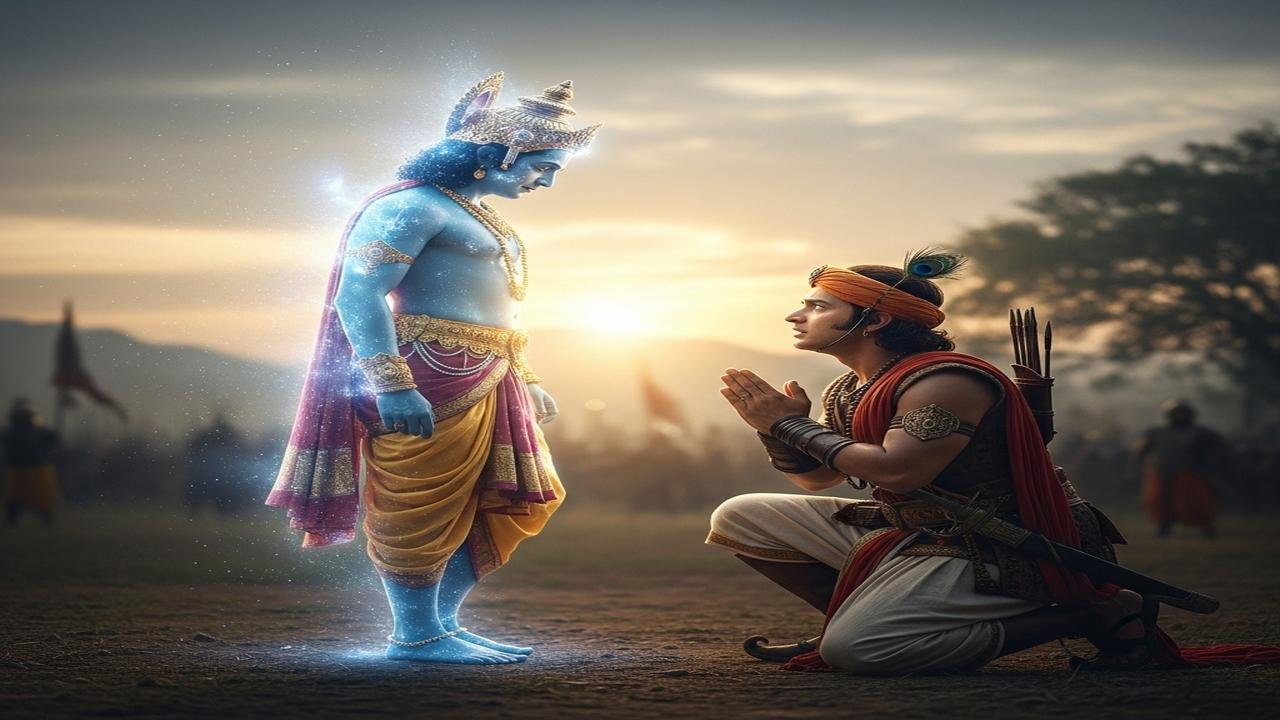
Setting: the cosmic revelation in Chapter 11
In the Bhagavad Gītā, the dramatic encounter often called the viśvarūpa darśana — the vision of the universal form — is narrated in Chapter 11. Arjuna, the warrior, asks Krishna to manifest that all-embracing, many‑faced form so he can understand the Lord’s cosmic role. The vision is overwhelming: Arjuna beholds an infinite, dazzling presence that contains creation, preservation and dissolution all at once. Toward the close of that chapter, shocked and awed, Arjuna asks Krishna to return to his familiar two‑armed, gentle form. That moment is small in words but rich in theological and psychological meaning.
What exactly does Arjuna request?
In the final verses of Chapter 11, after a long response to the vision, Arjuna says he is unnerved, confused and unsteady. He asks Krishna to withdraw the terrifying, all‑consuming aspect and reappear in the śrī or gentle, approachable form — the one that speaks to him privately on the battlefield. The narrative then continues: Krishna resumes his ordinary form and the teaching proceeds into the next chapters, notably Chapter 12, which turns explicitly to the path of devotion (bhakti — loving surrender).
Textual place and ritual resonance
The request comes at the end of the theophany episode (Chapter 11) and functions as a hinge in the Gītā’s structure: a full cosmic disclosure is given, and then the intimate instructions for living — action, devotion, concentration — follow. In many Gītā recitations and commentarial traditions, these verses are emphasised as an example of how transcendent revelation and personal relationship with the divine coexist.
How have commentators read Arjuna’s plea?
- Devotional (Vaiṣṇava) reading: Many Vaiṣṇava interpreters see Arjuna’s request as a move from awe to accessible love. The universal form proves Krishna’s divinity, but the devotee seeks the personal Lord who can reciprocate love and give practical guidance. Ramanuja‑inspired readings stress the Lord’s personal attributes and his intimate availability for the devotee.
- Non‑dual (Advaita) reading: Adi Shankaracharya’s view tends to place the vision as an encounter with the one reality behind multiplicity. In that light, Arjuna’s return to the “gentle form” can be read pedagogically: after a necessary awakening to the one Brahman, the teacher resumes a form the student can integrate within the world of action and ethical duty (dharma — ethical duty).
- Vaiśeṣika/Madhva readings: Dualist interpreters (e.g., Madhva) accept the literal theophany and emphasise a permanent ontological distinction between Krishna and the soul; here, the cosmic form proves divine supremacy, while the gentle form supports the devotional bond and service.
- Modern and psychological readings: Scholars and contemporary commentators often highlight human limits: Arjuna’s request is an example of how a human psyche cannot sustain absolute vision and needs a stabilising, compassionate form to translate spiritual insight into action.
Key themes and tensions
- Transcendence vs. immanence: The viśvarūpa stresses the Lord’s transcendence and cosmic sovereignty; the gentle form emphasises immanence and personal connection.
- Awe and ethics: Theophany evokes awe that can paralyse; the return to Krishna’s familiar form is a narrative strategy to resume ethical agency — Arjuna must fight, and he needs clear, relatable guidance to discharge his dharma.
- Pedagogy of revelation: The cosmic vision functions like a big‑picture lesson that frames the rest of the teaching. Then the teacher (Krishna) resumes a communicative, step‑by‑step mode suitable for practice.
- Limits of language and perception: The episode repeatedly underlines that human language and senses are inadequate for the divine; the two‑armed form is not a diminution but a pedagogical modality.
Practical and lived dimensions
In devotional practice, the sequence — overwhelming vision followed by approachable form — has analogues in many lived traditions. Festivals, temple iconography and classical drama often show both the majestic, multi‑armed cosmic imagery and the gentle, smiling deity. For many practitioners, that combination permits both reverence and intimacy: the deity is powerful enough to order the world and tender enough to listen to a single devotee’s plea.
In communal readings of the Gītā (study groups, discourses), the passage is frequently cited to teach that spiritual experience should lead back to responsible action and care for others, not to withdrawal or nihilism.
Careful notes and cautions
- Interpretations vary across schools and over time; treat any single reading as one voice among many rather than definitive scripture scholarship.
- If devotional practice involves intense breathwork, fasting or prolonged silence, consult experienced teachers and be mindful of physical and mental limits.
Why the moment still matters
Arjuna’s request to see the gentle form remains resonant because it models a crucial human need: to reconcile awe with access. The Gītā gives both a cosmic horizon and a personal teacher. That balance — between confronting the vastness of existence and preserving an intimate, teachable relation — is why the passage has retained centrality in devotional, philosophical and literary traditions across India.
Seen this way, the episode is less about retreating from the divine and more about making revelation useful: revelation that overwhelms must be shaped into guidance the human heart can accept and the human hand can enact.
