
Arjuna Refuses to Fight on Kurukshetra in Chapter 1

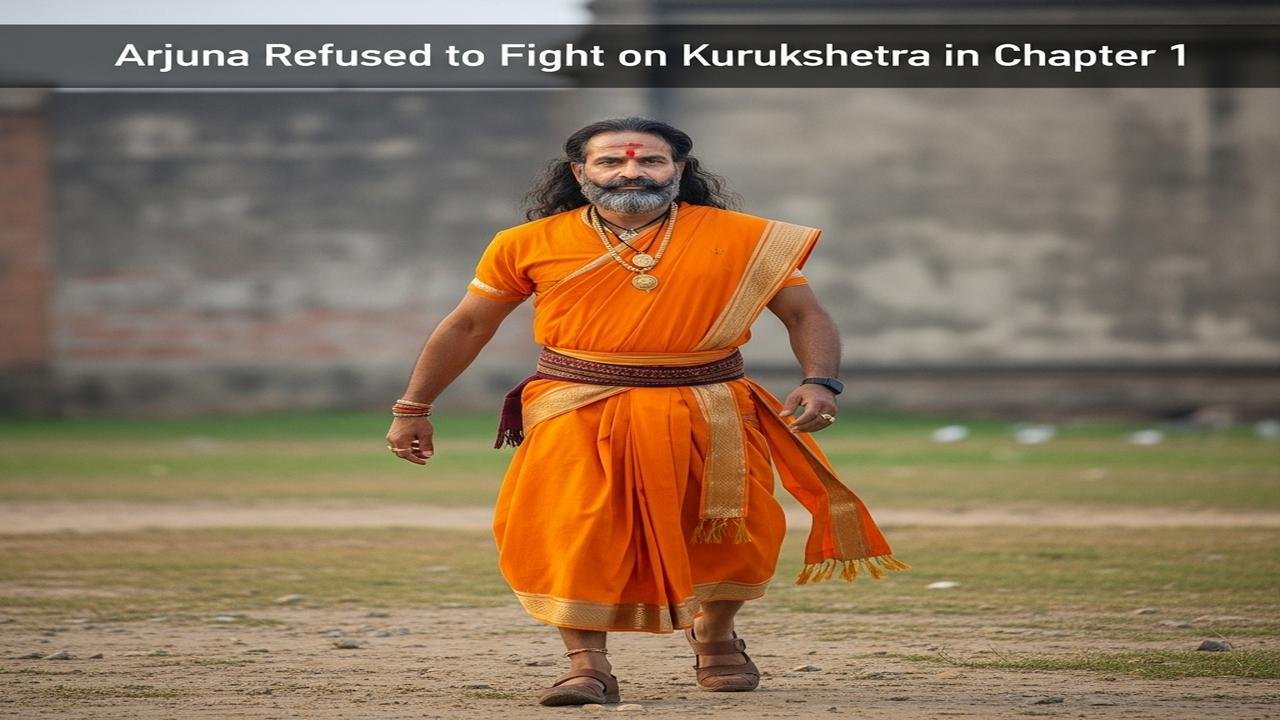
Arjuna refuses to fight: the scene on the battlefield
The episode begins on the plain of Kurukṣetra, just before the great battle between the Kauravas and the Pāṇḍavas. In the Mahābhārata narrative, and most famously in the Bhagavad Gītā (Chapter 1, traditionally titled Ārjuna-viṣāda-yoga — “the yoga of Arjuna’s dejection”), the warrior Arjuna surveys the two armies, recognises friends, teachers and relatives on both sides, and is overcome by sorrow.
Arjuna sets down his bow, lets his limbs fail, and sits down on the chariot between the wheels. The chariot’s reins remain in the hands of his charioteer, Krishna, who will respond by teaching over the next eighteen chapters. The moment of refusal — a trained warrior deciding not to fight — is the moral and dramatic hinge that brings the Gītā into being.
What the text actually describes
In Chapter 1 the narrative traces several linked reactions:
- Physical symptoms: dryness of the mouth, trembling, loss of control — the text presents Arjuna’s reaction as bodily as well as mental.
- Recognition and grief: seeing relatives, teachers and friends on both sides triggers compassion and sorrow for their possible deaths.
- Ethical perplexity: Arjuna questions the value of victory and kingdom if it means killing kin and honourable elders; he worries about sin (pāpa), social disorder and the destruction of family duties (dharma — ethical duty).
- Final decision: unable to resolve this conflict, Arjuna refuses to fight and sits down on his chariot.
Where this appears
The refusal occurs in the opening chapter of the Bhagavad Gītā and is also narrated within the larger account of the Bhīṣma Parva in the Mahābhārata. The Gītā frames the crisis so that Krishna’s counsel — whether read as spiritual teaching, philosophical argument, or the voice of providence — becomes necessary and authoritative.
Why this moment matters — layers of meaning
The episode invites many levels of reading. Different traditions and commentators highlight different dimensions, and none of these readings exhausts the scene.
- Psychological and human: Arjuna’s refusal is a human response to the moral costs of violence — a crisis of empathy and conscience that many readers recognise as deeply human.
- Ethical and social: For the classical āśrama and varṇa framework, Arjuna’s dilemma raises the question of a warrior’s duty (kṣatriya dharma) versus obligations to family and society. The Gītā’s later chapters address what duty means in action.
- Allegorical and spiritual: Many devotional and philosophical readings see Arjuna as the embodied seeker and Krishna as the guru or the divine Self. The refusal then dramatizes the seeker’s confusion before spiritual instruction.
- Literary and pedagogical: From a storytelling perspective, the collapse of Arjuna provides the narrative tension that allows the text to teach — without the crisis, there would be no instruction.
How different traditions interpret the refusal
Commentators and schools read the scene through their own lenses; here are some general tendencies without claiming exclusivity.
- Advaita Vedānta (Shankara): The crisis is existential ignorance; the Gītā’s teaching aims to remove false identifications and lead to jñāna (knowledge) of the Self.
- Vaiṣṇava readings (e.g., Rāmānuja, Madhva): Emphasise devotion and the role of Krishna as personal Lord; Arjuna’s confusion is resolved by surrender and bhakti (devotion) alongside ethical duty.
- Devotional and folk traditions: Often present Arjuna as a paradigmatic disciple whose candid questions legitimise doubt and longing in spiritual life.
- Modern interpreters: Scholars, social reformers and philosophers have read the scene in political, psychological, ethical and existential terms — from a study in righteous violence to a plea for non-violence (Gandhi read the Gītā in his own way).
Plurality and humility
Care is required: the text is ancient, multilayered and has been reinterpreted across centuries. Saying the episode “means” one thing risks erasing other living traditions of interpretation. The Gītā’s power partly comes from that very openness.
Practical and cultural echoes
The moment of Arjuna’s refusal has been rehearsed widely in Indian literature, drama, dance and devotional life. It is frequently cited in moral debates about duty and conscience, and it continues to be read in classrooms, temples and household shrines.
- As a teaching device it models an honest voice of doubt: asking questions publicly — even of the divine — is part of the tradition.
- As an ethical case, it remains a touchstone for discussions on war, responsibility and the costs of action.
Questions to reflect on
- What does “duty” mean when social obligations conflict with personal conscience?
- Is refusal a failure, a moral stance, or the start of deeper inquiry?
- How does the figure of the charioteer (Krishna) shape the meaning of Arjuna’s stance — as guide, friend, or divine counsellor?
The image of Arjuna sitting down in his chariot remains a profound spur to reflection. Whether read devotionally, philosophically, ethically or literarily, it invites us to hold ambiguity and to listen — to teachers, texts, and our own conscience — before choosing action.
