
Arjuna Trembles in Fear Before the Universal Form

Context: the request for a cosmic vision
The episode in which Arjuna trembles before the Universal Form appears in the Bhagavad Gita as chapter 11, usually titled Vishvarupa-darshana-yoga — the yoga of seeing the cosmic, or universal, form. The scene is set on the battlefield of Kurukshetra: a warrior-poet confronted with duty (dharma — ethical duty) asks his charioteer, Krishna, to reveal his true divine nature before the war begins. The request is framed as a desire to understand whom Arjuna is following, and whether the source of Krishna’s teaching is the limited human being he knows or something far greater.
How the vision is granted
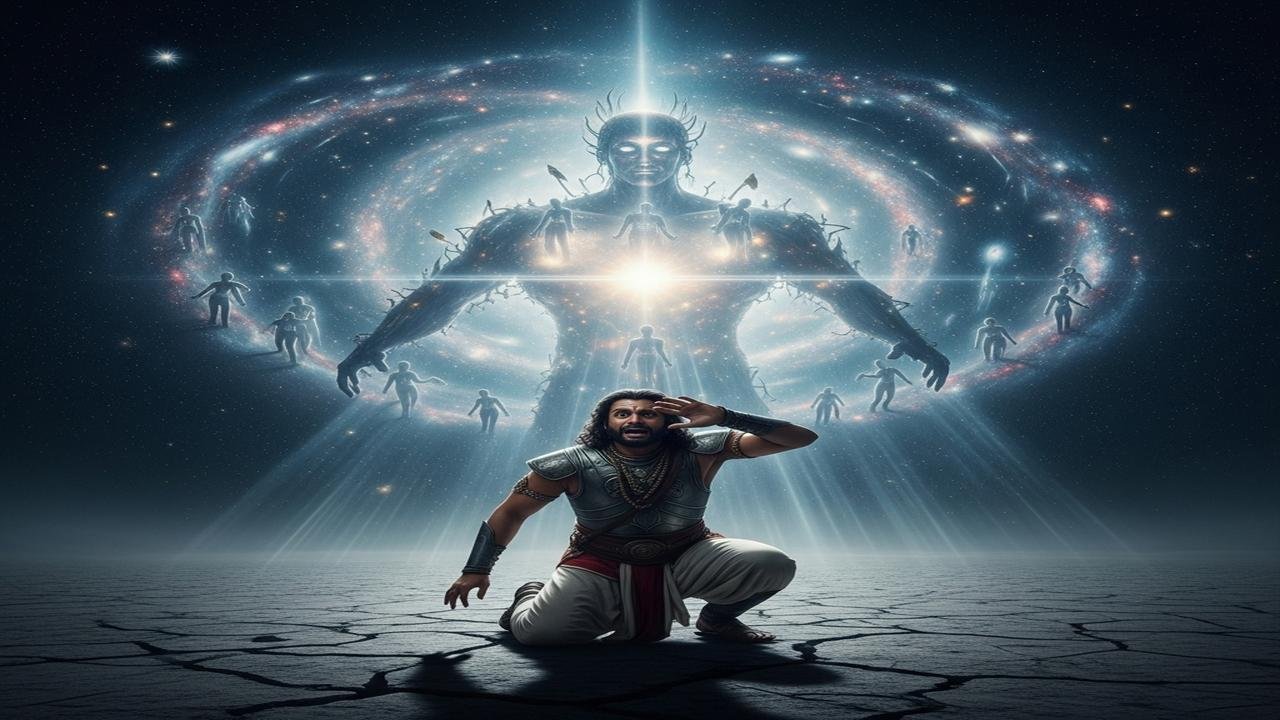
Krishna first grants Arjuna the divya cakshu — the “divine eye” — so that ordinary senses can perceive what is ordinarily hidden (Bhagavad Gita 11.8). Once that vision is given, Arjuna beholds a form that transcends any single body: countless faces, eyes, mouths, radiant weapons, and streams of beings moving into and out of the form. The Gita’s poetic catalogue (roughly chapters 11.5–11.30) stresses scale and plurality: the Universal Form contains all worlds, gods, creatures, and time itself.
Arjuna’s physical and emotional reaction
The text describes a classical human reaction to the encounter with the infinite. Arjuna trembles, his hair stands on end, his mouth dries, and his skin burns. These physiological metaphors underline a deeper existential disorientation: the familiar social and moral reference points collapse before a reality that is simultaneously creative and destructive. Arjuna alternates between awe, fear, praise, and pleading. In one of the most dramatic moments Krishna utters the phrase often translated as “I am Time, the great destroyer” (kutastho ‘smi), signalling that what is unfolding is not merely cosmic spectacle but divine agency at work in history (Bhagavad Gita 11.32).
Textual and interpretive layers
- Literal and devotional readings: Many Vaishnava traditions read the chapter devotionally: the Universal Form is the Lord’s revelation of omnipotence and majesty, prompting surrender (bhakti). Arjuna’s fear is thus a prelude to devotion and acceptance of Krishna’s will.
- Philosophical readings: Advaita commentators, such as Adi Shankaracharya, often interpret the vision as a symbolic exposure of the underlying Brahman (the impersonal absolute) behind multiplicity, while still allowing for the personal Lord as an aid for seekers. Ramanuja (Visishtadvaita) emphasises the personal aspect: the Universal Form demonstrates the Lord’s fullness and qualified unity, not an impersonal void. Madhva (Dvaita) insists on a real, eternal distinction between the Lord and individual souls even in this cosmic manifestation.
- Comparative and sectarian resonances: Elements of the “terrifying deity” motif appear across Hindu traditions. In some Śākta and Śaiva texts the Goddess or Shiva similarly reveals a vast, terrifying morphology to show power over destruction and renewal. The Gita’s Vishvarupa stands in a wider scriptural conversation about how the infinite can be shown to the finite.
Why Arjuna trembles — religious, literary, and psychological angles
There are several complementary ways to understand Arjuna’s fear:
- Epistemic shock: The human mind is confronted with a magnitude it cannot assimilate; the divine image breaks categories, producing vertigo rather than calm comprehension.
- Moral confrontation: Seeing the cosmic plan in which even those Arjuna loves are actors in a divinely ordained unfolding forces him to re-evaluate personal attachments and duties.
- Soteriological function: In many readings, the terror is purgative — it strips illusion and opens the way to surrender and right action. Fear here catalyses recognition and consequent embrace of duty and devotion.
How different traditions use the episode
- Bhakti traditions: Often stress the intimacy that follows the initial fear. After the vision, Arjuna prays, praises, and seeks instruction — a movement from fear to loving surrender that models the devotee’s path.
- Monistic schools: Use the episode to argue that the diversity of the world is a manifestation of an underlying unity; the terrifying multiplicity points beyond itself to the non-dual source.
- Tantric and goddess-centered readings: Observe parallels where the cosmic revelation is deliberately awe-inspiring, showing that power (śakti) and destruction are intrinsic to creation and liberation.
Art, ritual and modern reception
Artists, temple sculptors, and modern illustrators have long visualised the Vishvarupa with a multitude of limbs, faces and cosmic tableaux. In ritual contexts the scene feeds narratives of divine omnipresence and the reminder that the human vantage is limited. Contemporary teachers often draw on the episode to discuss ethical seriousness: that duty may be shaken by a vision of cosmic consequences but is reaffirmed by wisdom and surrender.
Closing reflection
Arjuna’s trembling is both a human moment and a theological hinge. It records how the encounter with the infinite unsettles the small self, and how that unsettlement can become the seed of surrender, courage, and renewed ethical clarity. Across commentarial lines — Vaiṣṇava, Śaiva, Śākta, Smārta, and philosophical schools — the episode remains a richly polyvalent reminder: the divine can overwhelm, terrify, and finally transform, inviting the seeker to move from awe to right action.
