
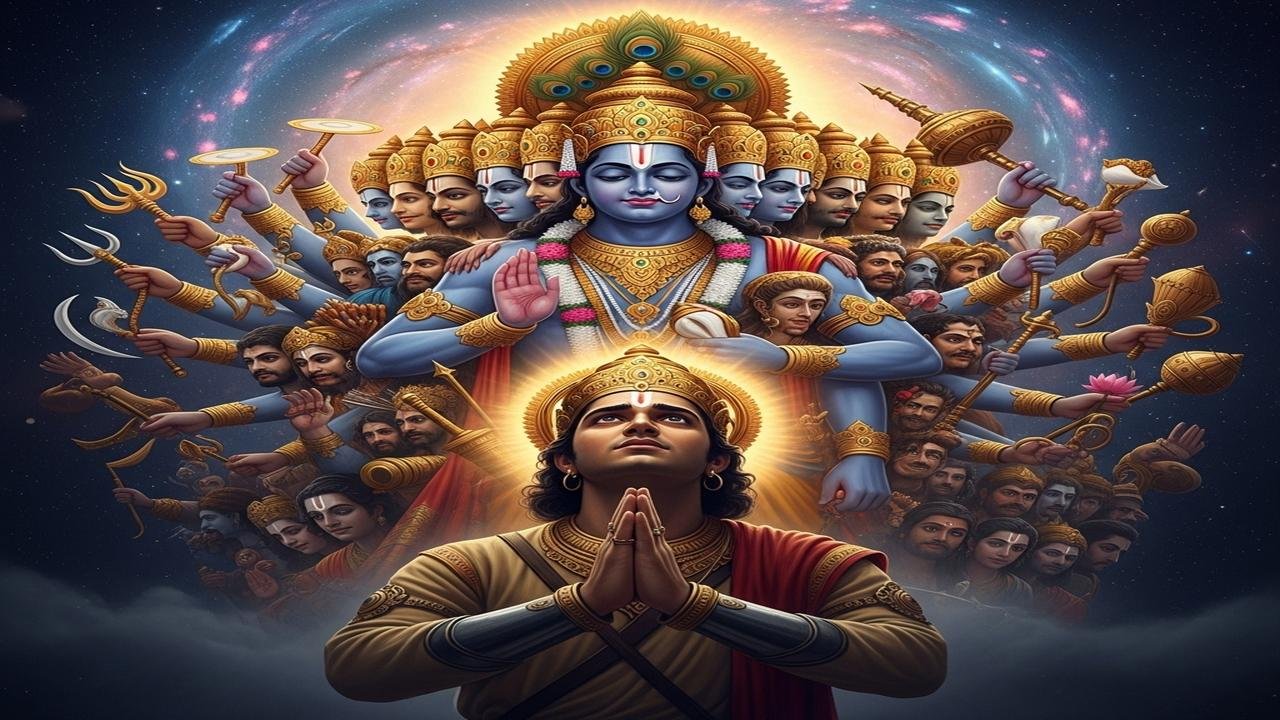
Arjuna Witnesses Infinite Faces and Arms in the Universal Form

Context within the Gītā and the Mahābhārata
The episode of Arjuna witnessing the universal form occurs in the Bhagavad Gītā (chapter 11), part of the larger Mahābhārata narrative. Krishna grants Arjuna a special divine vision so that he can see the Viśvarūpa — Visvarupa (universal form) — and understand Krishna’s nature as the source, sustainer and eater of the world. The chapter is often called Viśvarūpa-darśana-yoga — the yoga of seeing the universal form.
What Arjuna sees: key features of the vision
- Countless faces, eyes and mouths, implying infinite perspectives and voices.
- Many arms and ornaments, each bearing weapons or emblems, suggesting omnipotence acting in manifold ways.
- A cosmic light that floods horizons, suns and moons rising and setting simultaneously, and hosts of gods and beings moving within the form.
- Scenes of creation, preservation and dissolution seen together: living creatures appearing, fighting, and being consumed.
- Terror and awe: Arjuna is struck by fear and compassion; he prays for shelter even as he recognises the ultimate reality behind the spectacle.
How the Gītā frames the episode
Krishna first explains that ordinary senses cannot behold this vision; he grants Arjuna a divya cakṣu — a “divine eye” or spiritual sight. The purpose is didactic: to show the cosmic scope of Krishna’s being and to prepare Arjuna to accept his role in the war without personal hesitation. The vision resolves certain moral and ontological tensions in the dialogue between duty (dharma) and devotion.
Classical and later interpretations — a summary
- Advaita Vedānta (Shankara and followers): Many Advaita readings view the vision as pointing to the one non-dual reality (Brahman) manifesting as manifold forms. The cosmic form is sometimes read as a provisional, pedagogical appearance (upāya) that helps a devotee recognise the underlying unity beyond names and forms.
- Vishishtādvaita (Ramanuja): Ramanuja and his tradition read the Visvarupa as a real, theistic manifestation of Narayana’s infinite attributes: multiplicity does not negate the reality of the supreme person; rather it expresses divine opulence (vibhuti).
- Dvaita (Madhva): Dvaita commentators typically emphasise the categorical distinction between God and individual souls while holding the cosmic form as direct evidence of God’s sovereignty and supremacy over the universe.
- Bhakti traditions: Many devotional schools stress the ethical and emotional thrust: Arjuna’s fear, surrender and prayer model the devotee’s response to supreme revelation. Visvarupa serves as both awe-inspiring majesty and irresistible attractor to loving surrender.
- Other readings: In some Śaiva and Śākta texts the imagery of multiplicity — many faces, arms and eyes — appears too, but linked to other divine persons and functions. Scholars note theological cross-currents rather than a single, uniform meaning.
Art, temple imagery and ritual echoes
Elements of the Visvarupa appear in sculpture, painting and temple iconography across regions and periods. Sculptors often adapt the Gītā’s language—many faces, many hands, a ring of light—to local iconographic schemes. In narrative reliefs of the Mahābhārata the moment of revelation is depicted with Arjuna prostrate and a towering, composite deity above him.
Liturgically, the episode is evoked in recitations, in some evening discourses on the Gītā, and in festival storytelling where the purpose is to renew a sense of the divine as both immanent and transcendent. Different communities emphasise either the instructional, ethical side (why Arjuna must act) or the devotional, emotional side (how to respond to God).
Philosophical and ethical significance
The Visvarupa episode functions on several levels:
- Epistemic: It asserts that certain truths require a change in perception — a spiritual or revelatory seeing that transcends ordinary sense-knowledge.
- Ontological: It posits a reality in which unity and multiplicity coexist — the one manifesting as many without losing its unity, depending on the interpretive school.
- Ethical: The vision reorients Arjuna’s attachments. After seeing the universal form, he accepts his duty (dharma) within a broader cosmic framework.
Common misconceptions to avoid
- Reading the vision solely as spectacle: the Gītā situates the episode within a moral and spiritual teaching — it is not an isolated marvel.
- Assuming a single, uniform exegesis: classical commentators differ widely, and living traditions continue to emphasise different aspects (metaphysical, devotional, iconographic).
- Literalising every image: poets and scripture use metaphor and hyperbole to convey the incommensurable; not every descriptive detail must be taken as literal anatomy of a deity.
Practical notes and cautions
Contemplating the Visvarupa is a longstanding devotional and meditative theme. Practices may include recitation of chapter 11, guided reflection on its images, or visualisation exercises. If meditation or breathwork are new to you, practice under an experienced teacher and stop if you feel distress — these techniques can have strong psychological effects.
Concluding humility
The scene of Arjuna seeing “infinite faces and arms” is one of the Gītā’s most powerful reminders of the plurality within unity. It invites intellectual engagement, devotional response and ethical reorientation. Different schools read the episode through their own philosophical lenses, and that diversity is part of the Indian tradition’s strength: a single episode that continues to teach, unsettle and inspire across centuries and communities.
