
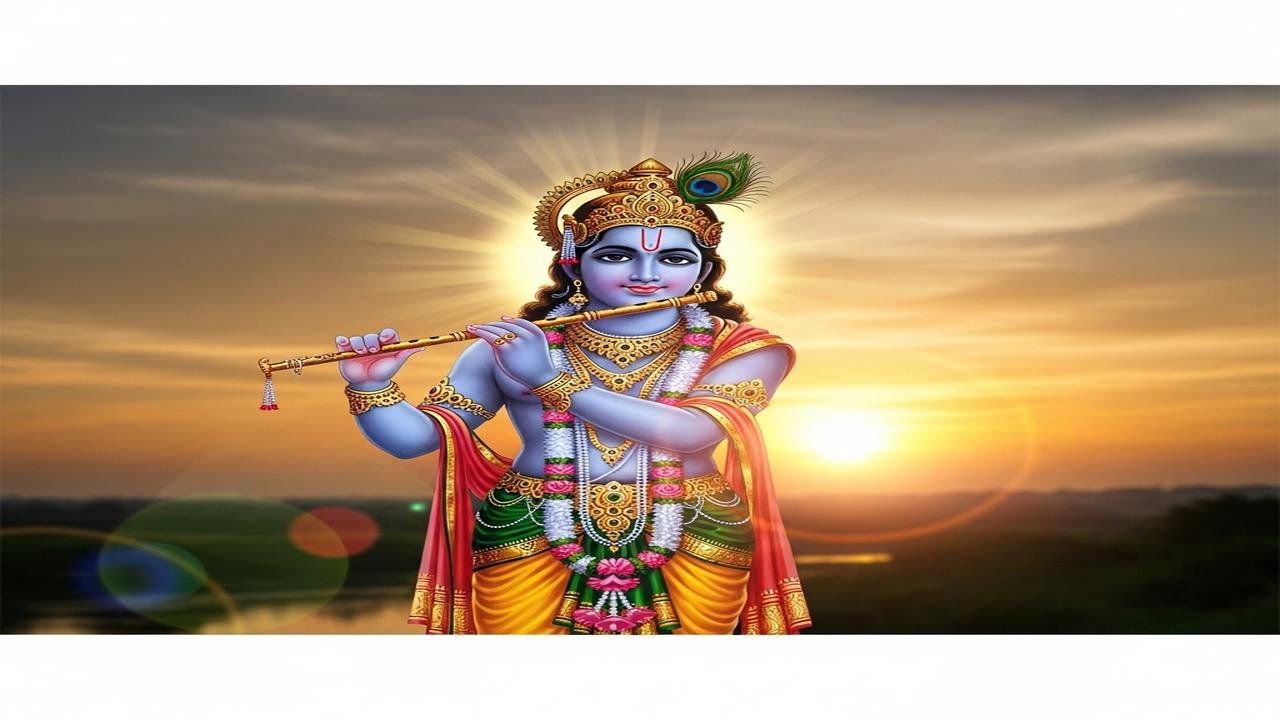
Krishna Declares He Is the Splendor of the Sun

Context: where the line appears
The sentence “I am the splendour of the sun” appears in the Bhagavad Gītā within Chapter 10, Vibhūti-yoga (the “Yoga of Divine Manifestations”), where Kṛṣṇa lists specific manifestations of his power. In many traditional English renderings the verse is given as Bhagavad Gītā 10.21 (sometimes discussed together with surrounding verses). The chapter is part of the Mahābhārata narrative and is framed as Arjuna’s request to see Kṛṣṇa’s opulent, immanent forms — the ways the divine appears in the world.
Key terms
- Vibhūti — divine manifestation or opulence;
- Gītā — “song,” the Bhagavad Gītā, a conversation between Arjuna and Kṛṣṇa;
- Avatar and svarūpa — respectively an incarnation and one’s essential form.
What the line literally says and evokes
In simple terms the line declares that one of Kṛṣṇa’s manifestations is the sun’s splendour. The image is compact: the sun (or sun’s brilliance) is taken as an expression of divine radiance and life-giving power. In Hindu poetic and philosophical language the sun commonly stands for light, vision, nourishment and the principle of illuminating knowledge (for example, buddhi or jñāna).
How different traditions read it
- Vaiṣṇava (devotional) readings: Most Vaiṣṇava commentators take the verse literally as a praise of Kṛṣṇa’s supreme, personal divinity. The sun is one of many created bright things through which the Lord’s glory shines; these are called his vibhūti. Devotional traditions stress a relationship of love and worship.
- Vedāntic/Advaita readings: Advaita commentators (following Śaṅkara) often interpret such verses metaphysically: the sun’s splendour can point to the one unchanging Brahman, the inner light of consciousness that illumines the world. Kṛṣṇa’s “I” may be read as the ultimate, impersonal ground rather than only a personal God.
- Viśiṣṭādvaita and Dvaita readings: Ramanuja’s school (Viśiṣṭādvaita) and Dvaita commentators preserve Kṛṣṇa’s personal transcendence while also accepting immanence — the divine can be both the inner soul of all and a distinct supreme being. They read the verse as one of many that establish both nearness and superiority of the Lord.
- Non-sectarian/contextual readings: Scholars and some Smārta readers emphasise that the Gītā’s descriptions are symbolic language meant to help human understanding; the sun-image functions pedagogically to readily convey the idea of illumination and power.
Textual and ritual place of the verse
Chapter 10 is a catalogue of divine manifestations: rivers, mountains, animals, gods, arts and cosmic phenomena are named as Kṛṣṇa’s expressions. The sun line participates in a long Indian habit of finding the sacred in ordinary and extraordinary features of nature. In many modern devotional settings the vibhūti verses are chanted in kīrtan or recited in study circles; ISKCON and other bhakti communities commonly sing translated lines as exaltations. In temple pūja the idea of the deity as the source of light connects to the practice of offering lamps (dīpa).
Philosophical layers: cosmology, ethics and self-knowledge
Beyond devotional praise, the sun-analogy carries philosophical work. Several classical commentators note that the sun represents three linked ideas:
- cosmic illumination — the sun gives light to the world, like the divine principle sustaining reality;
- intellectual illumination — the sun as symbol of knowledge or jñāna, the capacity that dispels ignorance;
- ethical radiance — the visible effects of divine presence are moral order, duty (dharma) and social harmony.
Different interpreters emphasise different layers: some stress moral transformation (the Lord’s presence inspires right action), while others emphasise metaphysical identity (the same light that reveals outer forms is the inner Self).
Comparisons with other scriptural traditions
Identification of the divine with the sun is not unique to the Gītā. Vedic hymns, Purāṇic stories and even Śaiva literature use solar imagery to express power and illumination. In Śaiva texts Shiva is sometimes celebrated as the inner light or as shining in the heart, and Śākta readings may see the sun as one aspect of the goddess’s manifest energy. These parallels are typically read as complementary rather than strictly competing: many Indian traditions accept that multiple deities express one ultimate reality, while retaining their own devotional focuses.
Practical implications for devotees and students
- Reading the verse devotionally encourages seeing sacredness in the natural world: sunrise, the light in the eyes, growth and warmth.
- Philosophically, it invites reflection on inner light — practices of study (śravaṇa), reflection (manana) and meditation (nididhyāsana) aim to let that light be personally realised. If you try intensive sādhanā (fasting or breath practices), do so under a qualified teacher and medical advice if needed.
- In communal worship the verse supports rituals involving light (lamps, aarti) and the poetic linking of worship with everyday experience.
Concluding note: a humble, inclusive reading
Kṛṣṇa’s statement that he is “the splendour of the sun” functions on several levels — poetic, theological and philosophical. For devotees it is an affirmation of the Lord’s manifest glory; for philosophers it can be a pointer toward the illuminating ground of knowledge; for ritualists it validates the central place of light in worship. Different schools read the same line in ways that fit their wider metaphysics; acknowledging those differences helps us appreciate both the depth of the verse and the plural ways in which Indian traditions make the divine intelligible and tangible in daily life.
