
Krishna On Kurukshetra: Three Paths From Darkness To Light

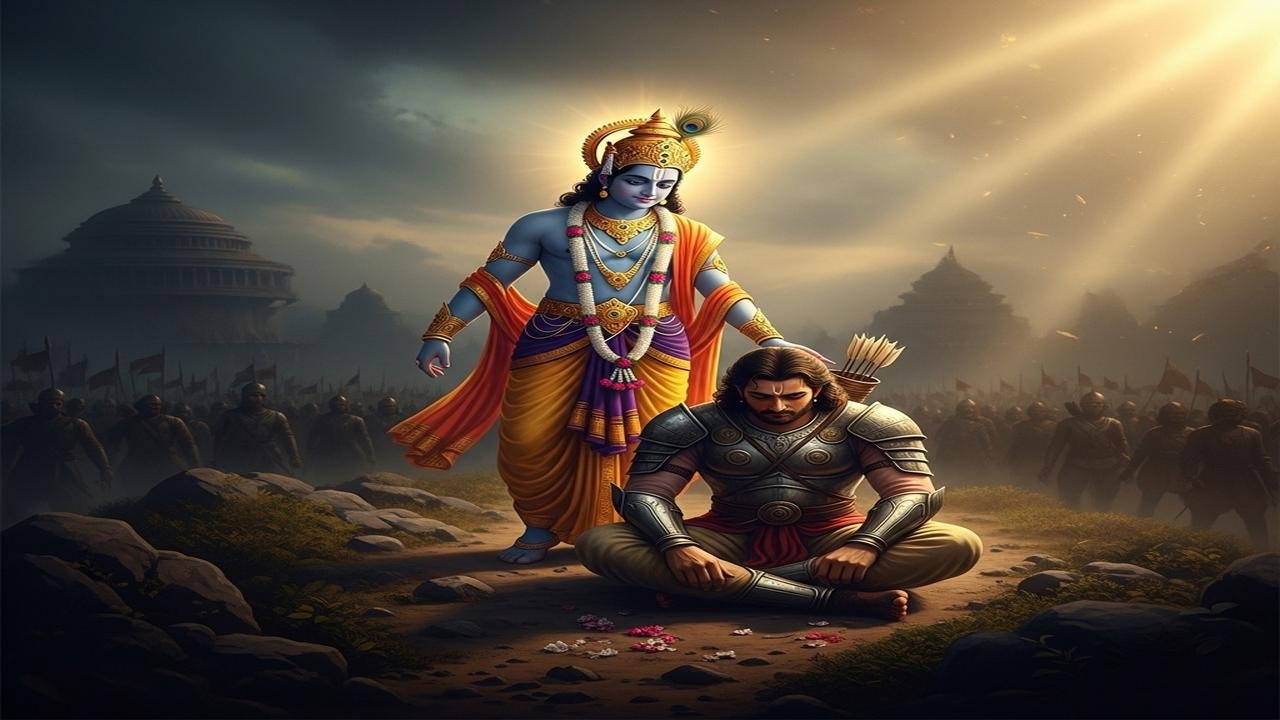
Setting: Krishna on the Battlefield
In the Bhagavad Gītā, Krishna speaks from the chariot of Arjuna at Kurukṣetra, answering a practical and existential crisis. The dialogue is often read as a manual for moving from darkness — avidyā, ignorance or moral confusion — toward light — vidyā, insight and liberated action. Different schools (Vaiṣṇava, Śaiva, Advaita, Smārta, Śākta) read the metaphors in their own idioms, but the Gītā’s basic distinction between ways that bind and ways that free is widely shared.
The two “paths” Krishna lays out — a concise map
Krishna does not offer a single one-size-fits-all program. He describes complementary routes that aim at the same shift from darkness to light.
- Karma-yoga — action without attachment: Performing duty (dharma — ethical duty) without claiming the fruits reduces the reactive cycle that sustains ignorance. The teaching appears especially in chapters 3 and 18, where right action is sanctified when dispassion guides the doer.
- Jnana-yoga — knowledge and discrimination: Self-knowledge and discernment (realising the distinction between the transient body and the enduring Self) remove the veil of error. Krishna’s expositions on knowledge and the nature of the self feature across chapters 2, 4 and 13.
- Bhakti-yoga — devotion: Sincere devotion to the Divine is presented as a direct, affective route. Chapter 12 focuses on loving surrender; later chapters unify devotion with knowledge and disinterested action.
Light and darkness in the Gītā’s practical vocabulary
Several technical categories help translate the metaphors into practice:
- Avidyā (ignorance) vs vidyā (knowledge): Ignorance is not merely lack of information, but the misidentification of the self with limited roles and desires. Knowledge is a lived reorientation of identity.
- The three gunas (qualities): In chapter 14 the Gītā explains sattva (clarity, balance), rajas (passion, restlessness) and tamas (inertia, confusion). Sattva is linked to illumination; tamas to darkness. The teaching is descriptive rather than moralistic: all gunas are present, and practice shifts their balance.
- Inner light as rule, not spectacle: Krishna’s language of light (e.g., divine radiance, vision of the cosmic form) points to an inner clarity that alters perception and action, not merely to intellectual assent.
How Krishna’s instructions translate into a day-to-day program
Krishna’s remedy for moving from darkness to light combines ethical practice, discipline, reflection and devotion. Key, repeatedly, is the reorientation of intention:
- Choose action aligned to duty, not ego-driven gain (see Gītā ch. 3).
- Develop steady attention through practice (Gītā ch. 6) — the mind is trained rather than forcibly suppressed.
- Study and discriminate: learn the limits of identification with roles, and rest in the abiding Self (ch. 4 and 13).
- Anchor life in devotion or surrender when that suits temperament (ch. 12), recognising that devotion can purify and concentrate the heart.
- Embrace renunciation of results rather than renunciation of action alone (ch. 18). Real renunciation is inner, not merely external withdrawal.
Different readings across traditions — shared cores, varied emphases
Commentators and communities stress different avenues.
- In many Vaiṣṇava readings, Krishna’s light is personal and relational: surrender to the Lord’s grace (bhakti) is primary.
- Advaita commentaries emphasise self-knowledge (jnāna) as the decisive light, reading devotional language as ultimately pointing to nondual realisation.
- Śaiva and Śākta traditions may reinterpret the imagery of light in terms of Śiva or the Goddess as inner luminous ground; ritual and mantra practices are highlighted as means to that illumination.
- Modern smarta and reformist interpreters often integrate ethical action, social responsibility and inward practices as mutually reinforcing.
Practical pointers from Krishna’s synthesis — a checklist
- Assess motive: Is the action aimed at personal acclaim, or at duty and the common good?
- Stabilise attention: regular practices (study, prayer, meditation) that suit one’s temperament.
- Use devotion or study as stabilisers: bhakti calms the heart; jnana refines outlook; karma-yoga keeps one engaged in the world.
- Watch the gunas: cultivate clarity (sattva) without fetishising passivity; transform restlessness into purposeful work.
- Seek guidance: a teacher, a community, or a trusted commentary helps translate scripture into responsible practice.
Notes of caution and humility
Krishna’s teachings are practical and flexible, but their application can be subtle. Scriptural language about “light” and “darkness” can be poetic and symbolic; careful interpretation matters. Practices that influence the body or breath—fasting, intense pranayama, prolonged silence—should be undertaken with awareness and, where needed, medical or experienced spiritual guidance.
Conclusion — a balanced, plural vision
Krishna’s account of light and darkness is not an abstract metaphysics but an invitation to transform how one acts, knows and loves. Across traditions the teachings are adapted to temperament and context, but the core remains: clarity arises when action is freed from ego-clinging, when knowledge dispels false identity, and when devotion opens the heart. The Gītā’s strength is its insistence that inner illumination is inseparable from right living — a path walked in the world, not above it.
