
Makar Sankranti: Why Gujarat Rooftops Fill With Kites

What Makar Sankranti marks
Makar Sankranti is a solar festival celebrated across the subcontinent on the day the Sun moves into Makara (Capricorn). The word sankranti — “transit” — refers to that solar ingress. Because it follows the solar calendar rather than the lunar one, it normally falls on 14 January (sometimes 15 January) in the Gregorian calendar. Ritual calendars and regional traditions vary, but common themes are the shortening of winter nights, the end of the harvest season, and grateful observance of the Sun’s renewed strength as it begins its apparent northward journey (called uttarāyaṇa, “moving north”).
Where kite flying fits in — a quick overview
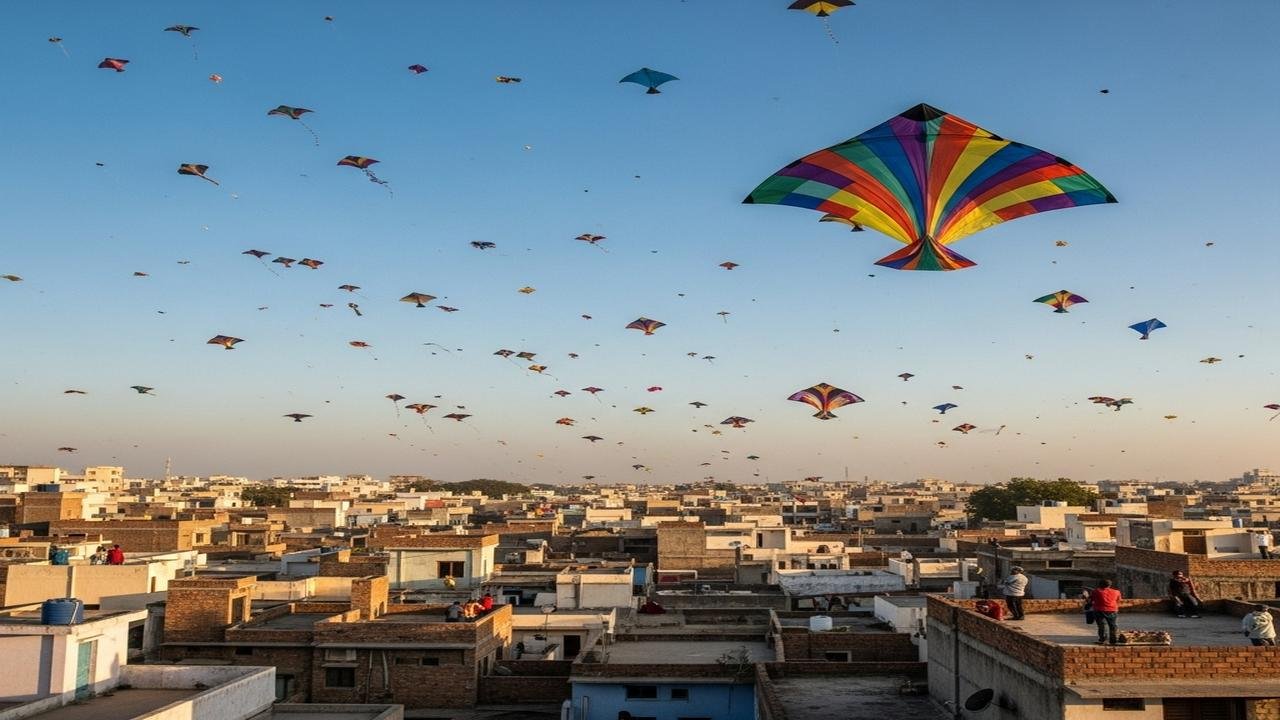
Kite flying is one visible, exuberant way many communities mark Makar Sankranti — especially in western and parts of northern India. The practice is not a universal liturgical requirement of the festival; rather, it is a regional cultural expression layered onto the festival’s astronomical and agrarian meanings. In states like Gujarat, Rajasthan and parts of Maharashtra the skyline filled with kites is an established hallmark of the day, while other regions emphasise different rituals (for example, Pongal in Tamil Nadu, Lohri in Punjab, and pitru tarpan / sesame-offerings in many areas).
Why kites? Practical, seasonal and symbolic reasons
- Favourable weather and rooftops: January offers clear skies, stable winds and cool but not severe temperatures. In many towns and cities, families use flat roofs for socialising and drying harvested crops — roofs are convenient places for flying kites safely away from crowded streets.
- Harvest leisure: Makar Sankranti coincides with the end of the winter harvest period in many regions. Kite flying provides a communal leisure activity that celebrates the labour just completed and the new season of food and prosperity.
- Saluting the Sun: Kites physically point toward the sky. Many participants and commentators read the activity as a joyful salute to Surya (the Sun), a way for communities to celebrate light and warmth returning after the cold months. In some households, prayers to the Sun and offerings are part of the day’s observances.
- Play and competition as cultural expression: Kite flying often develops into spirited contests: one kiteman tries to cut another’s line, symbolic of skill, bravado and social play. These contests foster neighbourhood bonds and inter-household rivalry in a festive frame.
- Public spectacle and civic identity: In cities such as Ahmedabad, the visual spectacle contributes to a shared civic culture and even tourism; governments and communities organise fairs, competitions and mass kite festivals.
Religious and literary echoes
Religious texts and popular memory amplify the auspiciousness of the Sun’s northward journey. For example, the Mahābhārata narrates that Bhīṣma chose to wait for the uttarāyaṇa to leave his body, and that motif has shaped perceptions of the period as spiritually significant. Different schools and commentators treat these stories as symbolic, devotional or ethical—linking the festival to ideas of dharma (ethical duty), the cyclical ordering of time, and the soul’s favourable moment for liberation.
Some devotional communities specifically honour Surya or local river deities on the day. But kite flying itself is best understood as a cultural supplement to the ritual core—an activity that channels communal joy, competition and the human impulse to gesture skyward on a day dedicated to the Sun.
Regional variety: not every Makar Sankranti is the same
- Gujarat: Known for large-scale kite flying (Uttarayan), with rooftops transformed into public arenas; international kite festivals are also common.
- Rajasthan and Maharashtra: Kite flying is widespread; in some places it is accompanied by fairs, food stalls and sweets made from sesame (til) and jaggery.
- Tamil Nadu (Pongal): The central rituals are boiling the first rice of the season, kolam floor designs and offering thanks to cattle and the Sun; kite flying appears in some coastal and urban communities but is not the ritual core.
- Punjab and Haryana: Related festivals like Lohri (mid-January) have different ritual emphases—bonfires, songs and social gathering—though kite flying may occur in pockets.
- Eastern India: In West Bengal and Odisha there are local harvest customs; kite flying is present in some cities but not uniformly central.
History and uncertainty
Scholars caution that the precise origin of kite flying as part of Makar Sankranti is difficult to date. Kites themselves have an ancient history in Asia, with early use in China and later spread and local adaptation across South and Southeast Asia. The ritual association of kites with Makar Sankranti appears to have grown organically where climatic, social and urban conditions favoured rooftop celebrations. In short: the practice is both old and regionally emergent, rather than a single provenance traceable to one text or decree.
Practical cautions and contemporary concerns
- Safety: Kite flying on crowded terraces and near electrical wires can be hazardous. People working on roofs, children and motorcyclists are at risk from abrupt falls or entanglement.
- Environmental and wildlife impact: Manja (glass-coated or abrasive strings) can injure birds and people. Many communities and municipal bodies urge the use of safer materials and restrict hazardous strings; some localities enforce fines.
- Respect and consent: In mixed neighbourhoods, large-scale kite battles and early-morning noise may disturb others; respectful timing and shared use of rooftops reduce disputes.
Note: If you plan intense outdoor activity or extended rooftop work, take standard safety precautions; seek medical advice for injuries if they occur.
Conclusion
Kite flying on Makar Sankranti is a rich, regional expression that combines seasonal practicality, communal joy, symbolic homage to the Sun, and spirited competition. It is one of many ways Indians mark the solar transition: not a uniform ritual mandate but a cultural language that communities have adopted and adapted over generations. As with many living traditions, contemporary concerns—safety, environment and urban living—shape how kite flying is practised today, and how communities keep the festival meaningful and responsible.
