
Sanjaya Declares Victory Lies with Krishna and Arjuna

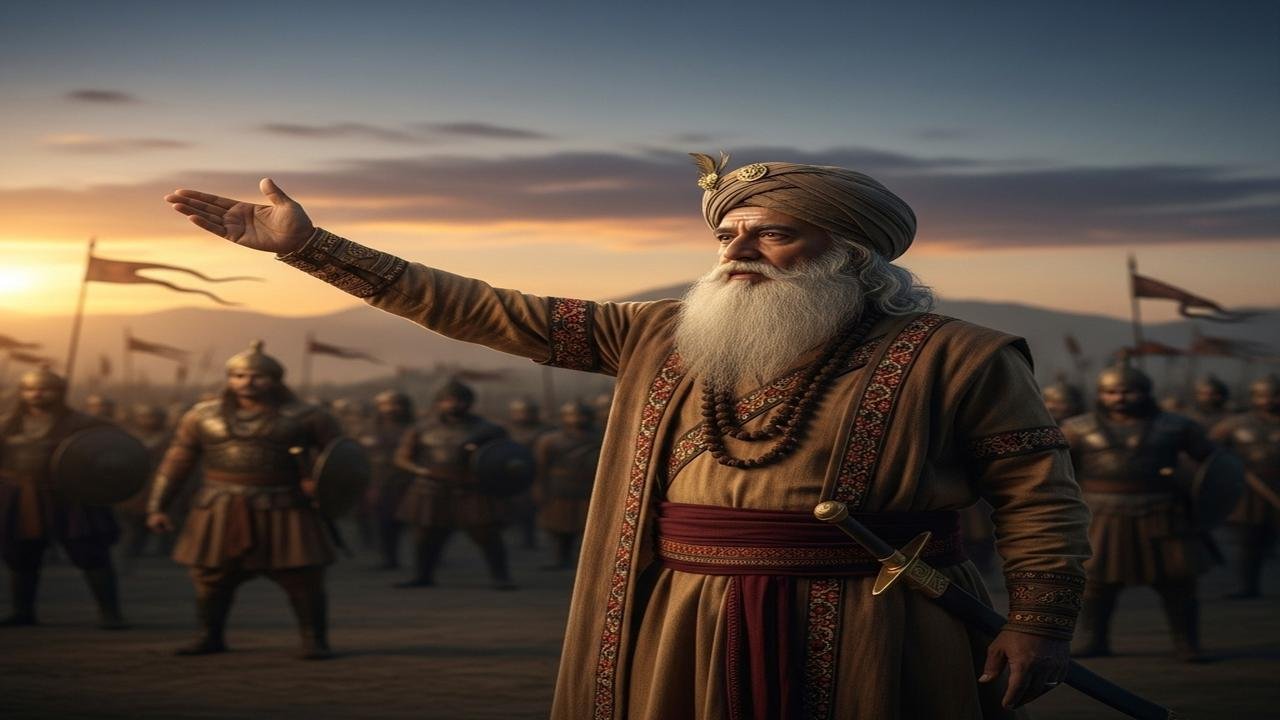
Sanjaya’s voice and the gift of vision
Sanjaya is one of the narrators at the heart of the Mahābhārata. Traditionally described as Dhṛtarāṣṭra’s charioteer and counsellor, he becomes the conduit through whom the blind king learns about the events of Kurukṣetra. When Vyāsa grants him divya-dṛṣṭi — divine sight — Sanjaya is able to witness battlefield happenings and report them in real time. That narrative device frames large parts of the epic, including the section that contains the Bhagavad Gītā, and lets the poem explore fate, responsibility and the relationship between the visible and the invisible.
What it means to say “victory lies with Krishna and Arjuna”
When commentators and readers say Sanjaya “declares victory lies with Krishna and Arjuna,” they are summarising a recurring narrative impression: the strategic acumen, moral clarity and spiritual authority associated with Krishna, together with Arjuna’s readiness to act after receiving counsel, tilt events in favour of the Pāṇḍavas. That statement can be read at several levels:
- Literary: Sanjaya’s reports set up dramatic irony. Dhṛtarāṣṭra frets, lacking sight; the reader or listener, through Sanjaya, sees the larger pattern emerging on the field.
- Theological: In Vaiṣṇava readings Krishna is the supreme reality and the battle’s outcome is seen as an expression of divine will. Here Sanjaya’s declaration echoes that conviction.
- Ethical and practical: Many interpreters emphasise that victory follows right action aligned with dharma — ethical duty — and prudent strategy, not mere fate or brute force.
Scriptural context
The Bhagavad Gītā itself appears within the Bhīṣma Parva section of the Mahābhārata. In the poem’s opening, Dhṛtarāṣṭra asks Sanjaya to describe the armies and leaders assembled on the plain. Sanjaya’s narration moves from battlefield description to the intimate scene of Arjuna’s crisis and Krishna’s instruction, and then back outward to the progress of the war. His commentary and later summaries allow the epic to present both worldly events and cosmological meaning side by side.
How different traditions read Sanjaya’s declaration
Readers from various śāstric and devotional traditions emphasise different implications:
- Vaiṣṇava (e.g., Rāmānujan, Madhva-influenced) views: Krishna is ultimately sovereign; Sanjaya’s sight reveals the divine plan. Victory with Krishna and Arjuna is therefore both foreordained and rooted in devotional relationship (bhakti).
- Advaita and jñāna-centred commentators (e.g., Śaṅkara tradition): The Gītā’s teaching is read as instruction toward self-knowledge. Victory is reinterpreted as the inner triumph over ignorance; Sanjaya’s reporting is a pedagogical frame rather than a literal decree of providence.
- Smārta and Śaiva readings: These often emphasise the universality of the Gītā’s ethical teaching. Sanjaya’s declaration becomes a prompt to examine duty, right action and the limits of power, rather than a narrowly sectarian claim.
Why the declaration matters for devotees and readers
That Sanjaya can declare victory has several implications for how the text is received and practised:
- It reassures the listener that moral order is not entirely at the mercy of short-term fortunes, offering a framework for hope in turmoil.
- It models the value of clear sight — literal and moral — as Sanjaya’s divya-dṛṣṭi shows what the king cannot see; many readers are invited to seek comparable clarity through study and reflection.
- It preserves moral ambiguity: even if victory falls to Krishna and Arjuna, the cost of war and ethical dilemmas remain central concerns of the epic.
Practical resonances in ritual and teaching
In temples, discourses and festival retellings, the Sanjaya episodes are often used to underline themes of guidance and witness. The episode is read aloud in many households and community gatherings during Mahābhārata recitations and Gītā study circles. Teachers point to Sanjaya as an exemplar of attentive, faithful narration — someone who listens, holds impartiality and reports difficult truths.
Note: any practices such as prolonged fasting, physical austerities or breathwork associated with religious observance should be approached with care; consult qualified practitioners and medical advice when relevant.
Concluding reflections
Sanjaya’s declaration that victory lies with Krishna and Arjuna is not a simple forecast of battlefield results. It is a compact symbol where narrative, theology and ethics meet. For some it affirms a divinely ordered cosmos; for others it prompts reflection on dharma, discrimination and the limits of human vision. Across traditions the episode continues to function as a mirror: it asks listeners to consider what kind of sight they cultivate — the short-range perception that panics, or the steadier vision that discerns duty, consequence and the larger moral arc.
