
Top 10 Hindu Baby Names Inspired by Lord Jagannath

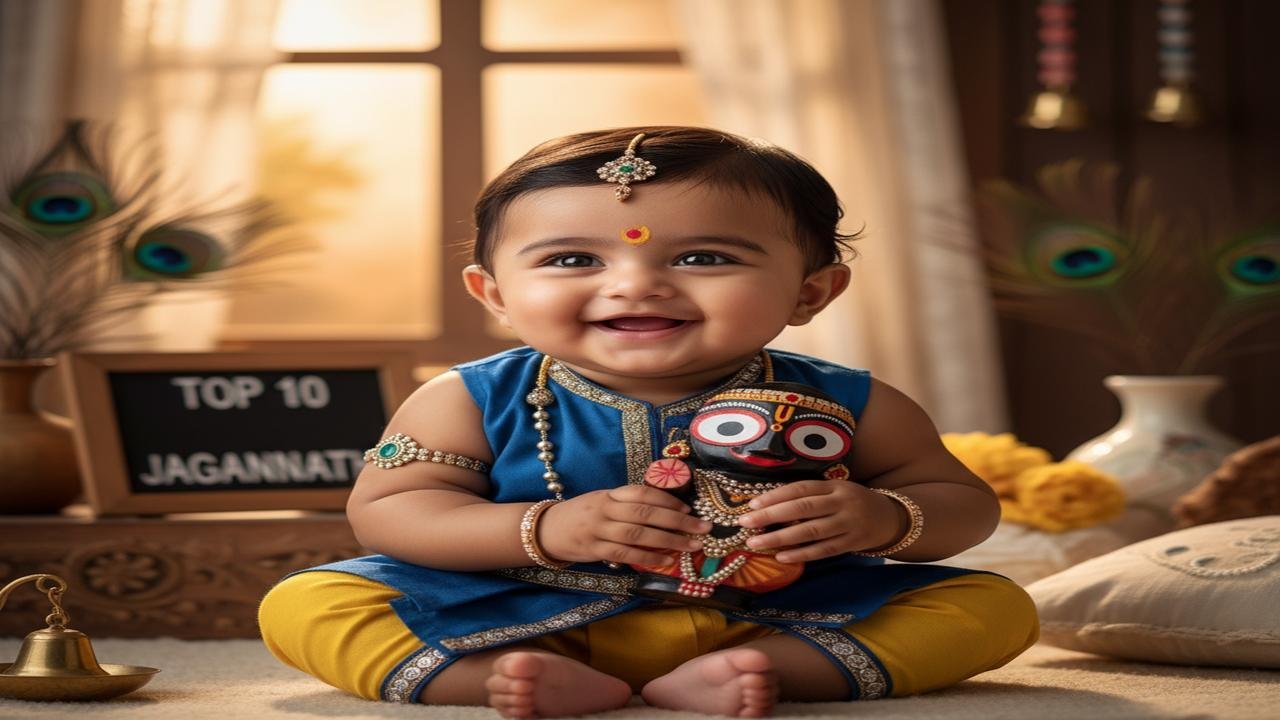
Jagannath — literally “Lord of the world” — is a distinctive form of Viṣṇu/Kṛṣṇa widely worshipped from Puri (Odisha) to Bengal and beyond. The triad of Jagannath, Balabhadra and Subhadra, the annual Ratha Yatra (chariot festival) and periodic rituals such as Snana Yatra and Nabakalebara shape a living vocabulary of names, epithets and images that many families draw on when naming a child. Below are ten baby-name options inspired by Lord Jagannath and the living traditions around him. Where helpful I give short etymologies, cultural context and common variants. (For naming ceremonies see *namakarana* — the traditional naming rite.)
1. Jagannath
- Meaning: “Lord (natha) of the world (jagat).”
- Gender: Typically male.
- Why it fits: The most direct name associated with the deity in Puri and across Vaishnava communities. Used by devotional families as a given name or as part of compound names (e.g., Jagannath Das).
- Variants/Notes: Sometimes shortened in speech to Jag, Jaga or Jaggu; in Bengal and Odisha the full form is also used as a respectful personal name.
2. Purushottam
- Meaning: “Supreme Person” (purusha = person; uttama = highest).
- Gender: Male.
- Why it fits: Puri is often called Purushottama Kshetra; Jagannath is worshipped as Purushottam in local and classical texts. The name stresses the Supreme Personality aspect familiar to many Hindu traditions.
- Variants/Notes: Purushottama, Purushotam are common spellings; respectful and widely accepted across Vaishnava and Smārta households.
3. Nilamadhav / Nilamadhava
- Meaning: “Blue Madhava” (nila = blue; Madhava = an epithet of Kṛṣṇa).
- Gender: Male.
- Why it fits: Early Odia traditions speak of an image called Nila Madhava that predated the present Jagannath icon at Nilachala (the “blue hill”). Naming after Nilamadhava connects to regional history and the colour-scheme of the deity.
- Variants/Notes: Often rendered Nilamadhav in Marathi/Gujarati contexts; can be used as a devotional name without sectarian connotations.
4. Niladri
- Meaning: “Blue mountain / hill.”
- Gender: Male, sometimes unisex.
- Why it fits: Niladri is a poetic name for the Puri hill where Jagannath resides; it appears in many ritual formulas (e.g., the ritual *Niladri Bije* performed after Ratha Yatra). It evokes place-based devotion.
- Variants/Notes: Nilachala is a close term used in local texts; Niladri is more commonly used as a personal name in Odisha and Bengal.
5. Balabhadra
- Meaning: “Strong (bala) brother” — the elder brother Balarāma.
- Gender: Male.
- Why it fits: Balabhadra is the elder brother in the Jagannath triad. Choosing this name honours that family‑like relationship and is traditional in many Odia families.
- Variants/Notes: Also seen as Baladeva or Baldev; widely used across regions and sects.
6. Subhadra
- Meaning: “Auspicious” or “fortunate.”
- Gender: Female.
- Why it fits: Subhadra is the sister in the Puri triad and a prominent female devotional name. It is traditional, classical, and well accepted across communities.
- Variants/Notes: Subhadra remains a popular name in Odia, Marathi, Kannada and other languages; it carries straightforward, positive meaning.
7. Madhava
- Meaning: An epithet of Kṛṣṇa (connected to the spring or the Yadu lineage).
- Gender: Male.
- Why it fits: Jagannath is regarded in many traditions as a form of Kṛṣṇa; Madhava is a devotional, pan-Indian name used by Vaishnavas and others.
- Variants/Notes: Madhav, Madhusudan are related names; classical resonance makes it a timeless choice.
8. Govinda
- Meaning: “Protector of cows” / a common name of Kṛṣṇa.
- Gender: Male.
- Why it fits: Govinda is chanted and sung frequently in Jagannath worship; it is devotional, melodic, and widely recognised across Vaishnava lineages.
- Variants/Notes: Short forms include Govind, Gobinda (Bengali/Odia). It is broadly acceptable socially and theologically.
9. Lokanath / Loknath
- Meaning: “Lord of the people/world.”
- Gender: Male.
- Why it fits: A synonym of Jagannath used in liturgy and place names; it carries a devotional but unpretentious tone as a personal name.
- Variants/Notes: Loknath is common in Bengal and Odisha; fits families who prefer a name that sounds familiar yet rooted.
10. Gauranga
- Meaning: “One with a golden (fair) body.”
- Gender: Male.
- Why it fits: Gauranga is the honorific name of Śrī Caitanya Mahāprabhu, a 16th‑century devotee whose movement centred much devotion on Jagannath in Bengal and Odisha. Families influenced by Gaudiya or related traditions may choose this name as an expression of bhakti that connects to Jagannath history.
- Variants/Notes: Often used in the Bengali devotional milieu; those outside Gaudiya circles may still appreciate its literary and devotional associations.
Choosing and using these names — a few practical notes
- Consider family tradition, pronunciation across languages and caste/community naming customs. Many families use the chosen deity-name with a family name or an honorific (e.g., Jagannath Das, Purushottam Rao).
- If you plan a traditional *namakarana*, speak with elders or a local priest about auspicious tithis (lunar day) — practices vary across regions and lineages; scholars and ritual manuals give different recommendations.
- Respecting diversity: These names are used by Vaishnava, Smārta and other households; acceptability can vary regionally, so consult family elders for sensitivities.
- Health caution: If baby-naming plans involve prolonged fasting or intense ritual participation by the mother, consult a healthcare provider — ritual practices should not endanger health.
All names above have classical roots and living use; some are specific to the Puri tradition, others are pan‑Vaishnava. If you would like a shortlist tailored to a particular language (Odia, Bengali, Gujarati, Marathi, Hindi) or a gender-neutral selection, tell me the region and I can refine the list further.
