
Yajna: Vedic Fire Rituals and Krishna’s Inner Sacrifice

What is yajna?
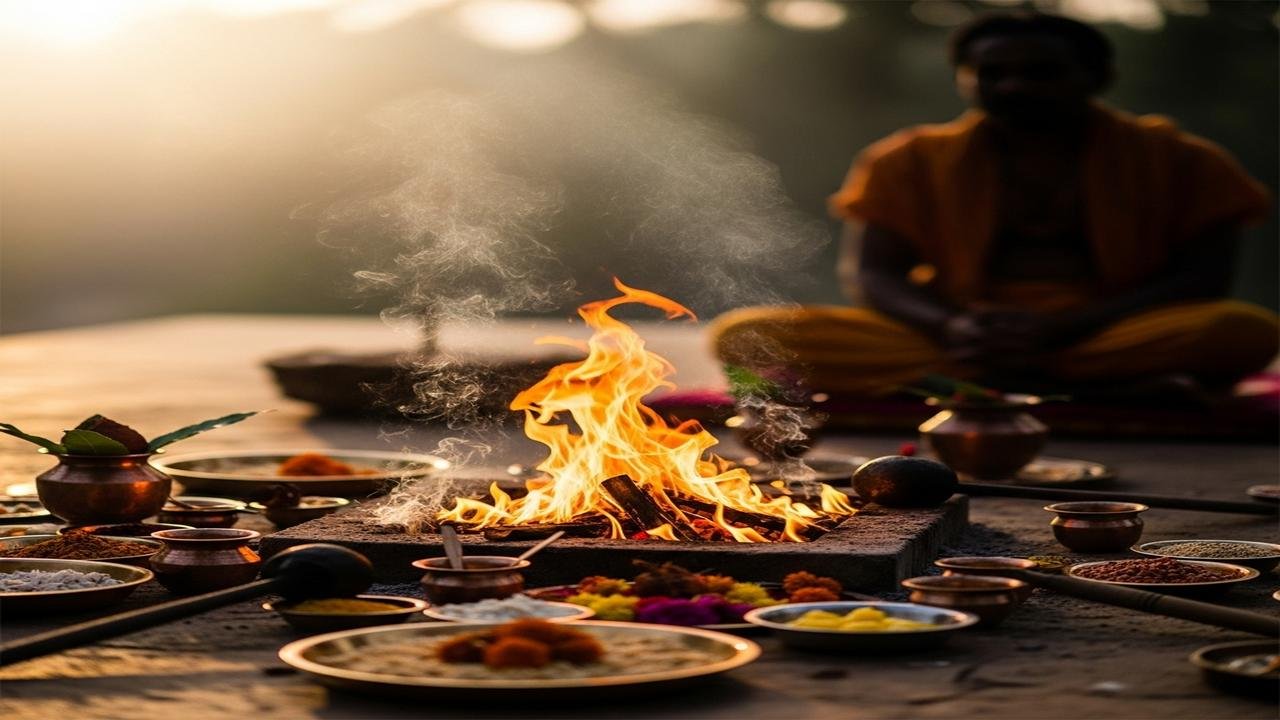
Yajna — often translated as “sacrifice” or “ritual offering” — is a foundational concept in Hindu thought that links human action, social order and cosmic balance. At its simplest, a yajna is an act of giving an offering (such as clarified butter, grains or soma) into a sacred fire or to a deity, but the term also covers an entire worldview in which action, reciprocity and duty sustain the world.
Yajna in the Vedic worldview
In the Vedas, yajna is described not merely as a human ritual but as the mechanism that maintains ṛta — the cosmic order. Hymns such as the Purusha Sūkta (Rigveda 10.90) present the cosmos itself as the result of a primordial sacrifice, where gods, humans and the world are woven together through giving and receiving.
- Ritual specialists (ṛtviks) performed elaborate public sacrifices (śrauta) involving Agni, Soma and many priests.
- Offerings were concrete: ghee, milk, grains and soma, addressed to particular deities who reciprocated in providence.
- Vedic ritual framed social roles and redistributed resources—sacrifices supported priests and fostered alliances.
Krishna’s account in the Bhagavad Gītā
Krishna speaks about yajna in several places in the Bhagavad Gītā, particularly in chapters 3 and 4. His treatment moves between the ritual and the ethical:
- He affirms traditional yajna as a social institution that sustains the world: offerings and duties keep the cycle of giving and receiving alive.
- He reframes the deeper meaning of yajna as karma-yajna — action performed without selfish attachment. Selfless work becomes a kind of sacrifice when offered to the Divine.
- Gītā commentators read these lines diversely: some (like Shankaracharya) highlight inner knowledge and renunciation; others (like Rāmānuja) see devotion and surrendered action as the heart of yajna.
From outer rites to inner sacrifice: Upaniṣadic and later readings
As the religious imagination moved from ritual to philosophy, many Upaniṣads reinterpreted yajna inwardly. In these texts, the fire becomes inner burning of desire, the offering becomes right knowledge and self-discipline. Two parallel trends developed:
- Philosophical internalisation: Yajna becomes meditation, study and moral action. The goal is liberation rather than ritual gain.
- Devotional reorientation: Medieval bhakti poets and teachers presented acts of devotion—singing, feeding devotees, and surrender—as yajña-like service to God.
Different schools kept different emphases. In Śaiva and Śākta Agamic ritual, elaborate homas (fire rites) continue as public cultic practice. In many Vaiṣṇava traditions, the sacrificial paradigm is retained but re-focused on devotion and grace.
How yajna is said to sustain cosmic balance
The traditional claim is not mystical in the sense of vague wishful thinking; it is an ordered reciprocity:
- Ritual actions produce offerings to gods and forces, and those powers are imagined to support agricultural fertility, rains and social prosperity.
- Socially, yajna structured obligations—kings, patrons, priests and recipients—maintaining the economic and moral order.
- Ethically, when action is performed selflessly (nishkāma karma), it neutralises personal selfishness and contributes to a stable social field.
Scholars often read this as a symbolic ecology: ritual acts signal gratitude and restraint, encouraging behaviors that actually help sustain the material basis of society, such as hospitality, food redistribution and ritual care for natural cycles.
Variations and contested practices
Diversity is the rule rather than the exception. Practices labelled yajna range from the small (daily agnihotra — sunrise/sunset fire offerings) to the vast (Vedic soma rites and gharma sacrifices). Some local traditions historically included animal offerings; others emphatically rejected them. Reform movements in the 19th and 20th centuries criticised blood sacrifice and promoted vegetarian, symbolic forms of yajna.
It is important to acknowledge differences without judgment: in some communities certain rites remain meaningful as communal identity; in others they have been transformed into symbolic, vegetarian or interior forms.
Yajna today: practice, ethics and public life
In contemporary India, yajna appears in multiple registers:
- Domestic ritual (household agnihotra, wedding homa), keeping continuity with family life.
- Temple homas and public yajñas, often performed on festivals to mark collective life.
- Devotional service framed as seva (service) or tapasya (discipline), described by many as a non-ritual yajna.
- New interpretations: ecological readings that treat yajna as a model of reciprocity with nature; social service framed as yajna-like gift economy.
When practices involve fasting, prolonged ritual, or breath practices, a short health caution is prudent: please consult a healthcare provider if you have medical conditions before undertaking strict fasts or intensive breathwork.
Conclusion: plurality within a single idea
Yajna is not a single unchanging practice but a layered concept that stretches from sacrificial fire to selfless action. In Vedic ritual it maintained cosmic order and social economy; in the Gītā and the Upaniṣads it acquires ethical and inward meanings; in devotional and Agamic worlds it continues as both public rite and personal surrender. Across Śaiva, Vaiṣṇava, Śākta and Smārta contexts the word keeps adapting, reflecting the living plurality of Hindu religious life. Respectful attention to those differences — and to the historical and social roles yajna has played — helps us see why Krishna could speak of sacrifice both as ritual and as the heart of moral action.
